


 Home /
AGV Battery Pack Supplier for Automatic Dock Charging Systems


Table of Contents
- Why Correct Docking Can Still End in Charging Failure
- Contact Resistance Becomes a Thermal Limit
- What Happens Electrically When an AGV Enters the Dock
- Direct Charging vs. Controlled Charging Handshake
- Opportunity Charging Changes Battery Sizing
- Match the Battery, Charger and AGV as One System
- Dock Hardware Needs Mechanical Validation
- What Should Be Monitored in Service?
- Standards Must Be Applied at the Correct Level
Automatic dock charging turns the battery into part of a closed control loop. For an AGV Battery Pack Supplier, the job is not simply to provide a 48V pack with enough Ah. The battery must match the charger, charging contacts, BMS logic, vehicle controller, docking accuracy, thermal conditions, and fleet duty cycle.

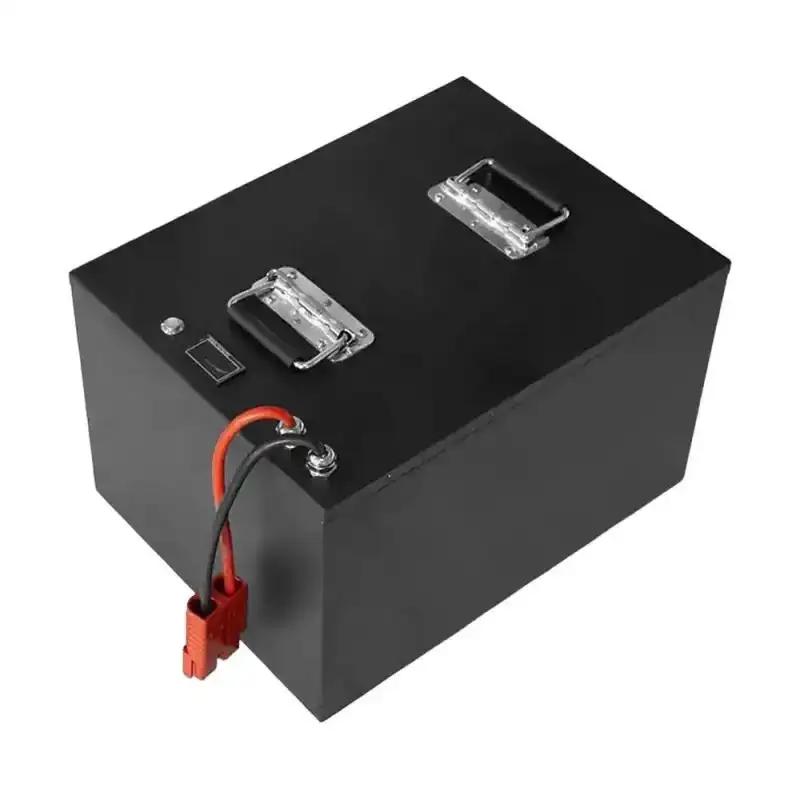
The Gloflux 48V AGV/robot platform uses 18650 or 21700 Li-ion cells, offers 10–50Ah capacity options, and can be customized for size, discharge current, connector, communication, cable length, enclosure, and installation method.
Why Correct Docking Can Still End in Charging Failure
A successful docking event only proves that the vehicle reached the station. Charging still requires:
•Low-resistance contact with adequate pressure
•Charger voltage inside the battery's permitted range
•BMS charge permission based on voltage, temperature, and fault status
•Valid charger-enable or communication signals
•Cables, fuses, terminals, and contacts rated for the required current
Contact Resistance Becomes a Thermal Limit
Dock contacts experience repeated mating, contamination, oxidation, vibration, and positioning error. Resistive loss follows:
P = I²R
If charging current doubles, heat rises fourfold at the same resistance. High-current docks therefore require control of contact pressure, contact area, cable gauge, connector temperature rise, and inspection intervals.
For an AGV Battery Pack Supplier, this means charge-current design cannot be separated from connector and dock-contact design.
What Happens Electrically When an AGV Enters the Dock
A controlled sequence typically follows:
Dock detected → Contact confirmed → BMS checked → Charger enabled → Current accepted → Voltage limit reached → Charge terminated
The BMS should monitor:
•Cell and pack voltage
•Charge current
•Cell temperature
•SOC
•Protection status
•Cell imbalance
Gloflux's 48V AGV platform integrates BMS protection against overcharge, over-discharge, overcurrent, short circuit, and overheating.
Direct Charging vs. Controlled Charging Handshake
| Design | Advantage | Engineering Trade-Off |
| Direct charger output | Simple architecture | Less control over charge-start sequence |
| Charger-enable handshake | Better start control | Requires signal integration |
| Fixed charge current | Simple charger logic | Limited response to SOC or temperature |
| Dynamic charge request | Better thermal control | Requires BMS/charger communication |
For higher-current AGVs, controlled charging can keep the charger disabled until docking and battery readiness are confirmed. Pre-charge or inrush-current control may also be required.
Gloflux supports optional SMBus, I²C, and CAN communication in custom battery-pack projects, allowing status and charging data to be exchanged where the AGV architecture requires it.
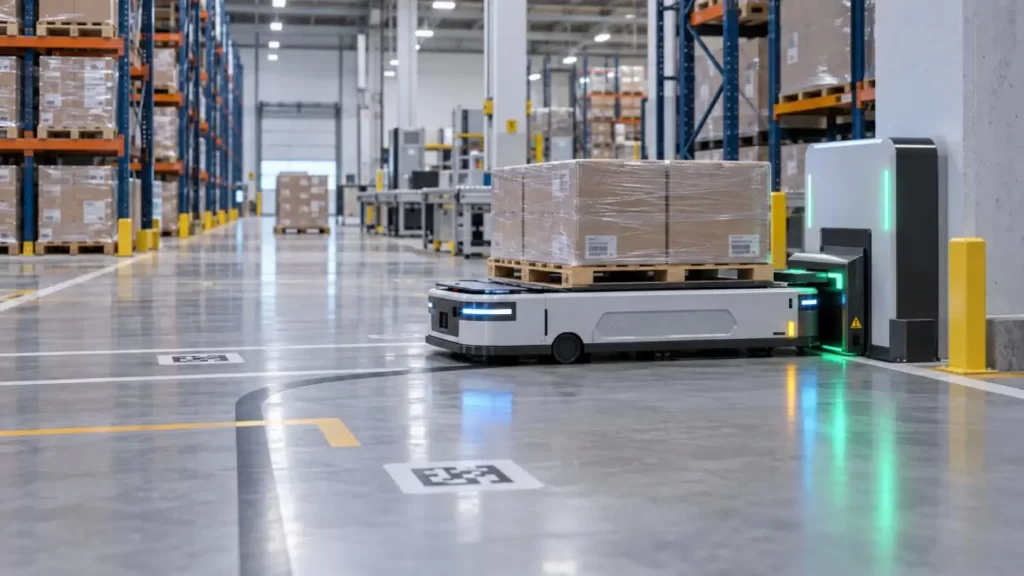
Opportunity Charging Changes Battery Sizing
Automatic docking makes partial-SOC charging practical. Instead of deep cycling, an AGV may repeatedly operate within a narrower range such as 35–70% SOC.
| Strategy | Large Pack + Fewer Charges | Smaller Pack + Opportunity Charging |
| Runtime | Longer | Shorter |
| Pack mass | Higher | Lower |
| Dock dependence | Lower | Higher |
| Charge frequency | Lower | Higher |
| Integration demand | Lower | Higher |
A qualified AGV Battery Pack Supplier should size the pack from usable energy rather than Ah alone:
Usable Energy ≈ Nominal Voltage × Capacity × Usable SOC Window
This must be checked against average power, peak current, route length, lift cycles, idle consumption, and available dock time.
Match the Battery, Charger and AGV as One System
A common mistake is assuming every "48V battery" matches every "48V charger." Maximum charge voltage, chemistry, series count, charge-current limit, and BMS strategy must also match.
Gloflux's 21700 AGV configuration uses a 13-series arrangement, 48V nominal voltage, and 54.6V charge voltage.
Before design begins, an AGV Battery Pack Supplier should receive:
•Nominal and maximum charge voltage
•Required Ah and Wh
•Average load and peak current
•Required runtime and dock-charging time
•Target SOC window
•Charger output limits
•Communication requirements
•Battery-space drawing
•Connector/contact specification
•Operating temperature and target market
These inputs determine cell configuration, conductor sizing, BMS thresholds, thermal margin, and pack geometry.
Dock Hardware Needs Mechanical Validation
Automatic charging is also a mechanical interface.
Alignment and Contact Pressure
Charging pads or spring contacts must tolerate realistic positioning error while maintaining stable pressure. Partial contact can increase voltage drop, heat, and charging interruptions.
Cable, Connector and Enclosure Integration
Strain relief, terminal orientation, enclosure material, mounting points, and cable routing affect reliability.
Gloflux supports customization of wiring, connectors, dimensions, enclosures, BMS functions, and installation structure, giving AGV OEMs more freedom to integrate the pack around an existing vehicle architecture.
What Should Be Monitored in Service?
For 24/7 Fleets, the following must be monitored:
•Contact discoloration or pitting
•Rising connector temps
•Multiple interrupted charges
•SOC drift / cell voltage delta
•BMS alarms
•Terminal looseness
•Communication problems
These signs are very important for opportunity charged fleets, because interrupted charges will eventually affect the availability of the vehicles and the scheduling of the entire fleet.
Standards Must Be Applied at the Correct Level
Battery, vehicle, and transport requirements are different:
•IEC 62619:2022 addresses industrial secondary lithium batteries and includes AGVs among industrial motive applications.
•ISO 3691-4:2023 covers safety requirements for driverless industrial trucks, including AGVs and AMRs.
•UN 38.3 addresses lithium-battery transport testing; it should not be treated as complete AGV system-safety validation.
An AGV Battery Pack Supplier should therefore confirm the compliance path for the exact battery configuration, vehicle category, destination market, and charging architecture rather than applying a generic certification list.
From Battery Specification to Fleet Validation
Supplier selection should follow an engineering sequence:
Requirement Review → Cell/BMS Design → Prototype → Dock Integration → Thermal/Current Validation → Fleet Test → Compliance → Mass Production
Gloflux supports custom lithium battery projects from cell selection and BMS development through prototyping, testing, and volume production. Its manufacturing base has more than 800 employees, a 30,000 m² facility, and annual lithium-battery capacity exceeding 100 million units.
For AGV OEMs evaluating an AGV Battery Pack Supplier, the best starting point is a complete electrical and mechanical requirement set—not only voltage and Ah. Gloflux can assess vehicle load, dock-charging time, BMS communication, connector layout, and available battery space to develop a battery pack around the AGV charging system as a whole.
FAQs
Q1. Does Gloflux provide custom AGV battery packs for automatic dock charging?
Yes. Gloflux supports customized AGV battery pack development based on vehicle voltage, capacity, installation space, connector type, charging interface, communication requirements, and operating conditions.
Q2. What voltage options can Gloflux provide for AGV battery systems?
Gloflux offers custom lithium battery solutions for different AGV voltage platforms. Its published AGV battery range includes a 48V nominal configuration, while other voltage requirements can be evaluated for OEM projects.
Q3. What capacity options are available for Gloflux AGV batteries?
Gloflux's published 48V AGV battery platform includes 10Ah, 15Ah, 20Ah, 30Ah, and 50Ah options. Capacity can also be matched to runtime, load profile, and dock-charging strategy.
Q4. Can Gloflux customize the BMS for an AGV battery pack?
Yes. Gloflux supports custom BMS development, including protection functions and communication requirements. The BMS can be designed around the AGV's voltage, current, temperature, and charging-control requirements.
Q5. Does Gloflux support CAN communication for AGV battery packs?
Yes. CAN is among the communication options Gloflux lists for customized battery projects. SMBus and I²C are also available depending on the system architecture.
Talk to the Manufacturer
Resources & Insights
High Capacity Lithium Battery for Wearables: High-Voltage LiPo Cell Design
2026-10-19
Cylindrical Battery Packs for Laptops: 2S vs 3S vs 4S Battery Design
2026-10-19
Stage Lighting Battery Pack: Prevent Voltage Drop & LED Flicker
2026-10-19

Best Rechargeable Batteries for Smart Devices: Performance, Safety, and Selection Guide
2026-10-19


