


 Home /
Best Rechargeable Batteries for Smart Devices: Performance, Safety, and Selection Guide


Table of Contents
- 1. Selecting the Right Rechargeable Battery Chemistry
- 2. Capacity, Energy Density and Real Operating Runtime
- 3. Battery Requirements for Different Smart Devices
- 4. Charging Protection, Battery Management, and Cycle Life
- 5. Standard vs Custom Rechargeable Batteries
- 6. GLOFLUX Manufacturing Precision and Process Control
- 7. Safety compliance and OEM purchasing verification.
For a battery to be considered the "Best Rechargeable Battery" for a device it must satisfy more than nominal capacity requirements. High mAh can be compensated for by a high internal resistance resulting in thermal runaway and/or a shutdown of the device. Additionally, less than optimal discharge characteristics can also cause thermal runaway.
At GLOFLUX, evaluation of battery selection encompasses several considerations including, usable energy, load behavior, charging behavior, mechanical tolerances, the integrity of the protection architecture and production uniformity. This allows for the selection of batteries that will allow a device to operate reliably over its service life.
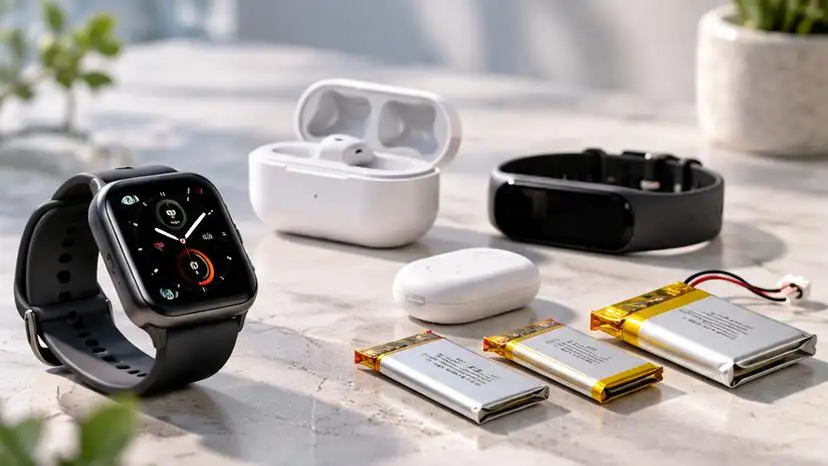
1. Selecting the Right Rechargeable Battery Chemistry
Selection of a rechargeable battery chemistry is highly application-dependent considering the voltage and available space in the device, the environmental conditions, the frequency of charging and the duration between charges.
| Battery Type | Engineering Advantages | Design Limitations | Suitable Devices |
| LiPo (Pouch Li-ion) | High energy density, thin, customizable geometry | Swelling requires mechanical protection and clearances | Wearables, earbuds |
| Cylindrical Li-ion | Standardized construction, established cell formats | Fixed geometry | Cameras, speakers |
| LiFePO4 | Thermal stability, cycle life | Lower energy density | Smart-home backup |
| NiMH | AA/AAA format, established technology | Lower nominal voltage | Remotes, peripherals |
LiPo vs. Cylindrical Li-ion
Pouch lithium-ion batteries can be easily configured to be thin, wide and/or long. Usable capacity is a function of sealing margins and available volume.
Established, mechanical formats of cylindrical cells require more space within irregular shapes.
Selection principle: Usable watt-hours / enclosure volume (volume including required space for battery) should be the basis for comparison instead of cell capacity alone.
2. Capacity, Energy Density and Real Operating Runtime
Why Wh Matters More Than mAh
For devices using multiple cells in series, like smart devices, energy becomes more pertinent than capacity.
Energy (Wh) = Voltage (V) x Capacity (Ah)
A 3.7V, 1000mAh battery has a nominal energy of 3.7 Wh.
Run time (h) = Useable energy (Wh) / Average power (W)
Useable energy is affected by the following
• Discharge cutoff: The amount of energy remaining when the device is discharged to its minimum voltage.
• Temperature: Lower temperatures increase the resistance of the battery and reduce its capacity.
• Aging: Capacity retention reduces over time with battery cycling.
• Conversion losses: DC-DC regulators increase the cell’s resistance and leads to increased energy loss.
For compact electronics, volumetric energy density (Wh/L) should also be considered.
Internal Resistance and Pulse-Load Stability
Peaks in current greater than the average loading current can occur in motor startup, audio amplification and wireless signal transmission.
Voltage Sag (V) = Peak Current (A) x Total Circuit Resistance (Ω)
Approx. Voltage sag = 0.27 V, with a total circuit resistance of 180 mΩ and a peak current of 1.5 A.
Pulse and Continuous discharge rates and pulse durations.
Internal DC resistance at a given temperature and SOC.
Terminal voltage at maximum load.
Temperature rise and Voltage recovery after several pulses.
A higher capacity battery is unacceptable if, during transient conditions, the voltage dips below the device’s operating threshold.
3. Battery Requirements for Different Smart Devices
| Critical Operating Condition | Primary Selection Criteria |
| Thin form factor and frequent charging | LiPo |
| High transmission current peaks | Low resistance, pulse capability |
| Intermittent transmission and long standby | Low leakage, storage stability |
| Dynamic continuous loading | Discharge capacity, thermal behavior |
| Peak heating and motor loads | Current peak, NTC |
For the design of IoT devices, runtime calculations must consider active duty cycles, BMS quiescent consumption and sleep current.
For motor driven devices, validation must account for startup current and repeated peak load conditions.
4. Charging Protection, Battery Management, and Cycle Life
The Best Rechargeable Batteries for Smart Devices require compatible charging electronics and properly coordinated protection thresholds.
PCM vs. Smart BMS
A basic PCM typically provides overcharge, over-discharge, overcurrent, and short-circuit protection.
More sophisticated configurations of BMS may also allow the user to:
• Monitor NTC temperatures.
• Estimate state-of-charge.
• Balance cells in applicable multi-cell packs.
• Communicate via SMBus, I²C, or CAN.
A protection circuit does not replace a compatible charging controller. Standard lithium-ion cells requiring 4.2V termination must not be charged using a higher-voltage profile unless specifically approved.

Cycle-Life Engineering
Cycle-life qualification should specify charge current, discharge rate, depth of discharge, temperature, and end-of-life capacity threshold.
High-temperature storage and prolonged high-SOC exposure can accelerate degradation. Protection limits must also avoid nuisance shutdown during normal current peaks.
5. Standard vs Custom Rechargeable Batteries
In some cases, development with standard cells is easier, as long as requirements on voltage, dimensions, and current ratings are satisfied.
In cases where other aspects, such as wiring, protection circuitry and overall pack performance, do not satisfy expectations, custom packs are required.
When working on OEM/ODM development at GLOFLUX, we consider:
• Electrical: Thermal management, continuous and pulsed current, capacity, and voltage.
• Mechanical: Cell swelling and assembly, sealing, cable routing, and dimensions and tolerances.
• Electronics: PCM/BMS and interfaces, connectors, and thermoelectric/Peltier modules.
• Manufacturing: Assembly and repeatability.
Precision and tolerance assessment is critical when evaluating tolerance-stack-up of packaging and tolerance of electrodes, heat-seal, insulation, and other aspects that affect conformance to product requirement and performance specifications.
6. GLOFLUX Manufacturing Precision and Process Control
Consistency in manufacturing is critical for rechargeable batteries for smart devices, as unbalanced and/or varied electrical specifications and dimensional variations in batteries can adversely impact automated assembly and reliability.
We have capacity to produce:
| Manufacturing Parameter | GLOFLUX Capability |
| Daily production capacity | 350,000+ units |
| Quality inspection checkpoints | 60+ |
| Engineering Services | Cell selection, PCM/BMS, OEM/ODM customization |
We can provide cells, and assist with PCM/BMS and other electronics integrations.
Electrical tolerances are specified in terms of product model, rather than universal tolerances for custom LiPo batteries.
For custom designs, dimensional acceptance limits should be established using approved engineering drawings and validated through inspection of prototypes and/or pilot production.
Manufacturing Verification
Our quality-control approach covers incoming materials, cell grading, assembly, protection testing, aging verification, and finished-pack inspection.
Critical production checks include:
• Distribution of cell capacities and internal cell resistances.
• Checks on cell voltages and connector polarities.
• Protection level activation and recovery.
• Insulation and dimensional conformity.
• Lot traceability and approved inspection records.
7. Safety compliance and OEM purchasing verification.
Battery qualification requires both supporting regulatory documentation and application specific testing.
Battery qualification requires both regulatory documentation and application-specific testing.
| Standard / Verification | Primary Purpose |
| IEC 62133-2 | Portable lithium battery safety |
| UN 38.3 | Transport-related lithium battery testing |
| Applicable UL/CB requirements | Product-specific safety conformity |
| Cycle and pulse-load tests | Runtime and degradation assessment |
| Thermal and mechanical tests | Environmental reliability |
Tests should only be performed on the cell or pack configuration specified.
Prior to engaging a supplier, the buyer should inform the supplier of the operating voltage, load profiles, enclosure drawings, charging requirements, thermal limits and failure mechanism, expected life, and targeted markets.

Develop Smart Device Battery Solutions with GLOFLUX
The optimized integration of electrical performance and safety of rechargeable cells, mechanical integration, and manufacturing for Smart Devices is critical.
At GLOFLUX, we support OEM/ODM battery development from initial specification review through prototype testing and mass production. To assist you in accomplishing your design goals, our engineers will evaluate a battery configuration to determine the best electrical and mechanical integration for your device.
FAQs
Q1. What rechargeable batteries does GLOFLUX offer for smart devices?
GLOFLUX provides customizable LiPo batteries, cylindrical lithium-ion cells, and rechargeable battery packs for wearables, IoT products, and portable electronics.
Q2. Can GLOFLUX customize battery dimensions for compact devices?
Yes. We customize battery thickness, width, length, and pack configurations according to device dimensions and manufacturing feasibility.
Q3. How does GLOFLUX select battery capacity for smart devices?
We evaluate operating voltage, average power consumption, peak current, target runtime, and available installation space.
Q4. Can GLOFLUX develop batteries for high-current smart devices?
Yes. We evaluate discharge-rate requirements, internal resistance, thermal conditions, and protection design for applications with high-current loads.
Q5. Does GLOFLUX provide customized PCM and BMS solutions?
Yes. We support overcharge, over-discharge, overcurrent, and short-circuit protection, with additional monitoring and communication functions when required.
Talk to the Manufacturer
Resources & Insights

High Capacity Lithium Battery for Wearables: High-Voltage LiPo Cell Design
2026-10-19
Cylindrical Battery Packs for Laptops: 2S vs 3S vs 4S Battery Design
2026-10-19

Stage Lighting Battery Pack: Prevent Voltage Drop & LED Flicker
2026-10-19
Best Rechargeable Batteries for Smart Devices: Performance, Safety, and Selection Guide
2026-10-19


