


 Home /
What Is the Difference Between Batteries in Series and Parallel?


Table of Contents
- What Happens When Batteries Are Connected in Series?
- What Happens When Batteries Are Connected in Parallel?
- What Are the Main Differences Between Series and Parallel Batteries?
- Can Batteries Be Connected in Both Series and Parallel?
- Which Configuration Provides More Battery Runtime?
- Do Series and Parallel Batteries Need Different BMS Designs?
- What Should You Consider Before Choosing a Battery Configuration?
-
FAQ
- Can I Connect Lithium Batteries in Series?
- Does Connecting Batteries in Parallel Increase Voltage?
- Which Is Better, Series or Parallel Batteries?
- Can I Connect Batteries With Different Capacities?
- Does a Series Connection Increase Battery Capacity?
- Can I Use the Same BMS for Series and Parallel Batteries?
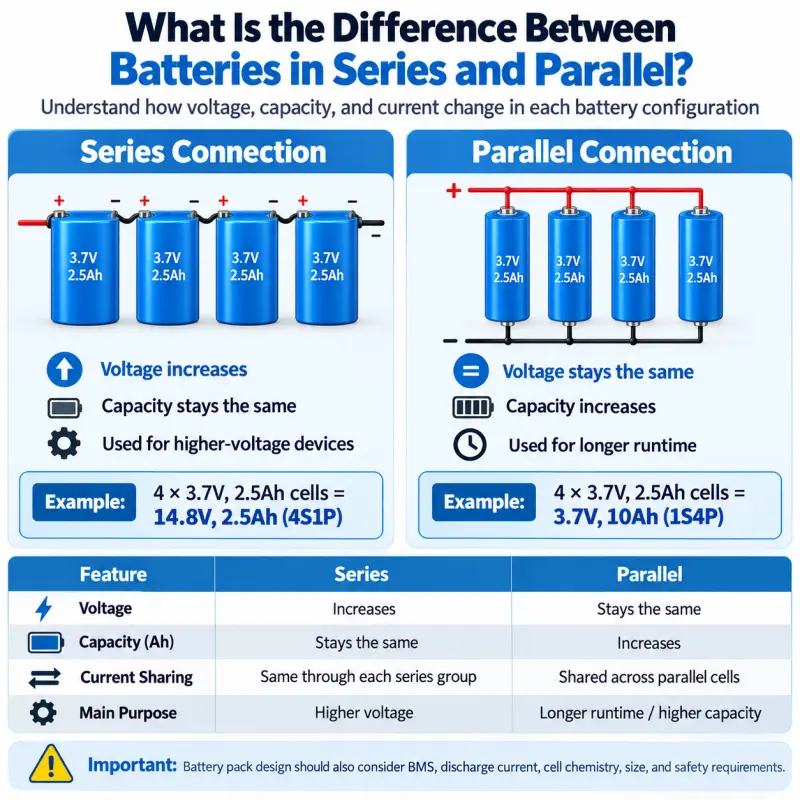
Batteries in series and parallel are connected differently to achieve specific voltage, capacity, and current requirements. Series connections increase battery voltage, while parallel connections increase capacity and available current without changing nominal voltage.
Understanding these differences is essential when designing lithium battery packs for medical devices, industrial equipment, portable electronics, and other applications. The correct configuration depends on your device's electrical requirements, expected runtime, and battery management system.
What Happens When Batteries Are Connected in Series?
A series connection joins the positive terminal of one cell to the negative terminal of another, creating a higher-voltage battery system.
The total voltage equals the sum of the individual cell voltages, while the capacity in amp-hours (Ah) remains unchanged.
For example, connecting four identical 3.7V, 2500mAh lithium-ion cells in series produces:
- Nominal voltage: 14.8V
- Capacity: 2500mAh
- Configuration: 4S1P
- Nominal energy: 37Wh
Series connections are commonly used when electronic devices require higher operating voltages than a single cell can provide.
However, the charging system and BMS must support the complete series configuration.
What Happens When Batteries Are Connected in Parallel?
A parallel connection joins the positive terminals of cells together and connects their negative terminals together.
Unlike series connections, parallel configurations maintain the same nominal voltage while increasing total capacity.
For example, four identical 3.7V, 2500mAh cells connected in parallel produce:
- Nominal voltage: 3.7V
- Capacity: 10,000mAh
- Configuration: 1S4P
- Nominal energy: 37Wh
Parallel connections can extend operating time and increase available discharge current, provided the cells, wiring, and protection system are appropriately designed.
For applications requiring longer operating time, see GLOFLUX's guide to calculating battery runtime from Ah and Wh.
What Are the Main Differences Between Series and Parallel Batteries?
The primary differences involve voltage, capacity, current distribution, and battery management requirements.
The following table compares the two configurations.
| Feature | Series Connection | Parallel Connection |
|---|---|---|
| Voltage | Increases | Remains unchanged |
| Capacity (Ah) | Remains unchanged | Increases |
| Total energy | Increases with added cells | Increases with added cells |
| Current | Same current flows through each series group | Current is shared between parallel cells |
| Main purpose | Achieve higher voltage | Increase capacity and available current |
| Typical configuration | 4S1P | 1S4P |
Both configurations increase total stored energy when additional identical cells are added.
The difference is how that energy is delivered to the connected equipment.
Can Batteries Be Connected in Both Series and Parallel?
Yes. Many lithium battery packs combine series and parallel connections to achieve the required voltage and capacity simultaneously.
For example, a 4S2P battery pack contains eight cells arranged into four series groups, with two cells connected in parallel within each group.
Using 3.7V, 2500mAh cells, the resulting specifications are:
| Configuration | Voltage | Capacity | Total Cells |
|---|---|---|---|
| 4S1P | 14.8V | 2500mAh | 4 |
| 1S4P | 3.7V | 10,000mAh | 4 |
| 2S2P | 7.4V | 5000mAh | 4 |
| 4S2P | 14.8V | 5000mAh | 8 |
The appropriate combination depends on the device's operating voltage, power consumption, available installation space, and expected runtime.
Before choosing a configuration, determine the required capacity using our battery capacity calculation guide.
Which Configuration Provides More Battery Runtime?
Battery runtime depends primarily on usable stored energy and actual power consumption, rather than the series or parallel arrangement alone.
Consider two battery packs containing four identical 3.7V, 2500mAh cells.
A 4S1P configuration delivers 14.8V and 2.5Ah, while a 1S4P configuration delivers 3.7V and 10Ah.
Both provide approximately 37Wh of nominal energy.
Under equivalent load conditions, their theoretical operating times are similar. Actual runtime may differ because of voltage conversion efficiency, discharge current, temperature, and battery protection limits.
Therefore, comparing battery runtime using Ah alone can be misleading when pack voltages differ.
Do Series and Parallel Batteries Need Different BMS Designs?
Yes. The battery management system must match the battery chemistry, series count, charging requirements, and expected operating current.
Series-connected lithium battery packs generally require monitoring of individual series groups. Cell balancing may also be necessary to manage differences between groups.
Parallel-connected cells operate at approximately the same voltage, but current sharing, cell matching, and appropriate protection remain essential.
For additional information, read How to Choose the Right BMS for a Lithium Battery Pack.
What Should You Consider Before Choosing a Battery Configuration?
The correct configuration requires more than selecting a suitable voltage or capacity.
Engineers should evaluate the device's continuous and peak current requirements, battery chemistry, charging voltage, temperature range, mechanical dimensions, and applicable safety standards.
Cells must also be appropriately matched. Combining incompatible cells can cause uneven current sharing, excessive heating, or premature battery failure.
GLOFLUX provides custom lithium battery solutions for OEM applications, including cell selection, series-parallel configuration, BMS integration, connector customization, and battery pack development.
FAQ
Can I Connect Lithium Batteries in Series?
Yes, provided the cells are compatible and the complete battery system is properly engineered. The charger, protection circuit, and BMS must match the series configuration and cell specifications.
Does Connecting Batteries in Parallel Increase Voltage?
No. Parallel connections maintain approximately the same nominal voltage while increasing total capacity and potentially increasing available discharge current.
Which Is Better, Series or Parallel Batteries?
Neither configuration is universally better. Series connections provide higher voltage, while parallel connections provide greater capacity at the same voltage. Many applications require a combination of both.
Can I Connect Batteries With Different Capacities?
Mixing cells with different capacities, ages, or electrical characteristics is generally discouraged. Uneven cell performance can cause imbalances and reduce battery reliability.
Does a Series Connection Increase Battery Capacity?
A series connection increases voltage but does not increase the pack's Ah rating. However, adding identical cells in series increases the total nominal energy measured in watt-hours.
Can I Use the Same BMS for Series and Parallel Batteries?
Not necessarily. A BMS must match the battery's series count, chemistry, current requirements, and protection specifications. A BMS designed for one configuration should not be assumed compatible with another.
Talk to the Manufacturer
Resources & Insights

High Capacity Lithium Battery for Wearables: High-Voltage LiPo Cell Design
2026-10-19
Cylindrical Battery Packs for Laptops: 2S vs 3S vs 4S Battery Design
2026-10-19

Stage Lighting Battery Pack: Prevent Voltage Drop & LED Flicker
2026-10-19

Best Rechargeable Batteries for Smart Devices: Performance, Safety, and Selection Guide
2026-10-19


