


 Home /
How Do I Calculate Battery Runtime from Ah and Wh?


Table of Contents
- What Is the Basic Battery Runtime Formula?
- How Do I Convert Ah to Wh?
- How Do I Calculate Runtime from Wh?
- Should I Include Efficiency Losses?
- Why Is Actual Battery Runtime Often Shorter?
- How Do I Calculate Runtime for a Changing Load?
- Should I Add a Safety Margin?
- Is Battery Runtime the Same as Battery Life?
- What Information Should I Give a Battery Manufacturer?
- Final Answer
- FAQ
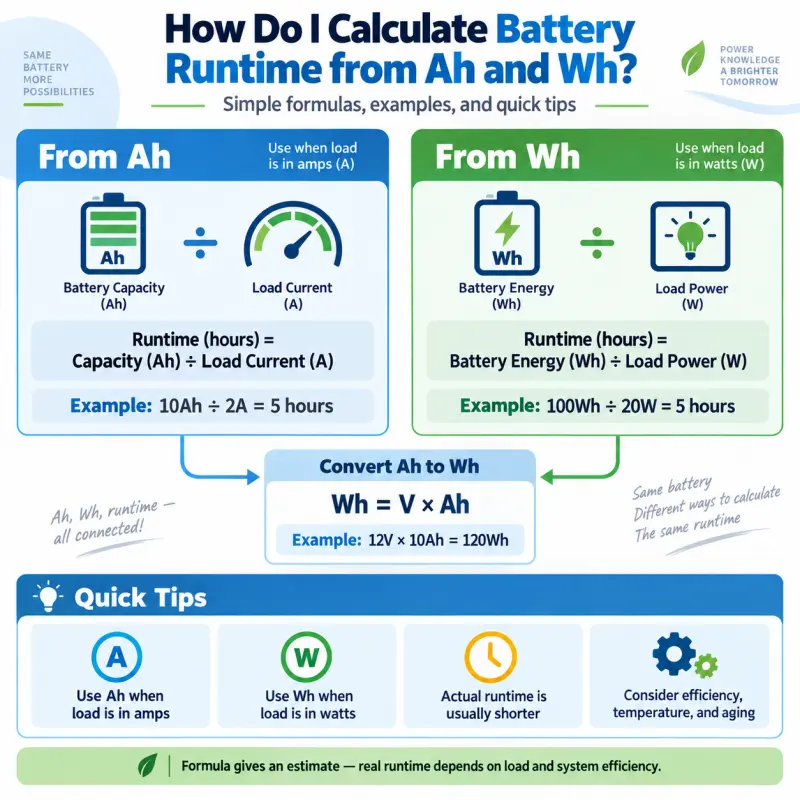
Battery runtime tells you approximately how long a battery can power a device before it needs to be recharged. The calculation is straightforward when you know battery capacity and average load, but you need to use the correct units.
If your load is specified in amps, you can estimate runtime from amp-hours (Ah). If your device is specified in watts, watt-hours (Wh) are usually more useful because Wh includes both voltage and capacity.
What Is the Basic Battery Runtime Formula?
When capacity is given in Ah and average load current is known:
Runtime (hours) = Battery Capacity (Ah) ÷ Load Current (A)
For example, a 10Ah battery supplying an average 2A load has a theoretical runtime of:
10Ah ÷ 2A = 5 hours
When battery energy is given in Wh and device power is known:
Runtime (hours) = Battery Energy (Wh) ÷ Load Power (W)
A 100Wh battery powering a 20W device therefore has a theoretical runtime of:
100Wh ÷ 20W = 5 hours
These formulas provide a starting estimate, not a guaranteed operating time.
How Do I Convert Ah to Wh?
Use:
Energy (Wh) = Voltage (V) × Capacity (Ah)
For example, a 12V 10Ah battery contains approximately:
12V × 10Ah = 120Wh
A 24V 10Ah battery contains approximately 240Wh. Both are rated at 10Ah, but the 24V battery stores about twice the nominal energy.
This is why Ah alone should not be used to compare batteries with different voltages.
If you are selecting capacity for a new product, see How to Calculate Battery Capacity for a Device.
How Do I Calculate Runtime from Wh?
Suppose a battery is rated at 14.8V and 5Ah.
First calculate nominal energy:
14.8V × 5Ah = 74Wh
If the device consumes 10W continuously:
74Wh ÷ 10W = 7.4 hours
The theoretical runtime is approximately 7.4 hours. If the same device consumes 20W, theoretical runtime drops to about 3.7 hours.
Should I Include Efficiency Losses?
Yes. Real systems are not 100% efficient. Energy can be lost through DC-DC converters, inverters, wiring, connectors, the BMS, and other electronics.
A more practical formula is:
Estimated Runtime = Battery Wh × System Efficiency ÷ Load Power
For example, a 100Wh battery supplies a 20W load through a system with 90% efficiency:
100Wh × 0.90 ÷ 20W = 4.5 hours
Without including efficiency, the simple calculation would give 5 hours.
Why Is Actual Battery Runtime Often Shorter?
Several factors can reduce usable runtime.
Battery voltage falls during discharge, while high current can cause additional voltage sag. Cold temperatures can reduce available capacity, and aging gradually reduces the amount of energy the cells can store.
The BMS may also disconnect the pack before all nameplate energy is used to protect the cells from excessive discharge.
Other factors include standby consumption, conversion losses, current spikes, connector resistance, and changing operating modes.
For higher-current applications, also confirm that the BMS and cells can support the required load. See How to Calculate BMS Current for a Lithium Battery Pack.
How Do I Calculate Runtime for a Changing Load?
If a device switches between operating modes, use average energy consumption instead of maximum power alone.
For example, during each hour a device uses:
- 30W for 10 minutes
- 10W for 20 minutes
- 2W for 30 minutes
The energy consumed is:
30W × 10/60h = 5Wh
10W × 20/60h = 3.33Wh
2W × 30/60h = 1Wh
Total consumption is approximately 9.33Wh per hour.
If the battery has 93.3Wh of usable energy, estimated runtime is about 10 hours under that duty cycle.
Should I Add a Safety Margin?
Usually, yes. A battery sized exactly to the theoretical requirement may fall short after accounting for temperature, aging, conversion losses, and load variation.
The required margin depends on the application and reliability target. Portable consumer electronics, medical devices, industrial equipment, and communication products may require different reserves.
Is Battery Runtime the Same as Battery Life?
No. Battery runtime describes how long the battery powers a device on one charge.
Battery life usually describes how long the battery remains usable over months or years. Cycle count, charging conditions, storage, temperature, and depth of discharge all influence long-term battery life.
What Information Should I Give a Battery Manufacturer?
For a custom battery pack, provide device voltage, average power, peak power, continuous current, peak current, required runtime, operating temperature, charging method, available dimensions, and connector requirements.
For products with motors, heaters, pumps, or wireless transmitters, an actual load profile is especially useful.
GLOFLUX can use this information to match battery capacity, voltage, cells, BMS or protection circuit, wiring, connector, and mechanical design to the application.
Final Answer
The two basic battery runtime formulas are:
Runtime = Ah ÷ A
and:
Runtime = Wh ÷ W
Wh is generally more useful when comparing batteries at different voltages because it represents energy. For a realistic estimate, also consider efficiency, usable capacity, temperature, aging, voltage sag, BMS cutoff settings, and changing load conditions.
FAQ
Can I calculate battery runtime using only Ah?
Yes. If you know the average battery current, divide capacity in Ah by current in amps.
How do I calculate Wh from Ah?
Multiply battery voltage by capacity in Ah. For example, 12V × 10Ah = 120Wh.
How long will a 100Wh battery run a 20W device?
The theoretical runtime is 5 hours. Actual runtime may be shorter because of system losses and operating conditions.
Why is Wh better than Ah for comparing batteries?
Wh includes both battery voltage and capacity, making it a better measure of stored energy.
Does a higher Ah rating always mean longer runtime?
Only when comparing batteries at the same voltage and under similar load conditions.
How accurate is a battery runtime calculation?
It is an estimate. Actual runtime depends on load profile, efficiency, temperature, battery condition, discharge rate, and protection settings.
Talk to the Manufacturer
Resources & Insights

High Capacity Lithium Battery for Wearables: High-Voltage LiPo Cell Design
2026-10-19

Cylindrical Battery Packs for Laptops: 2S vs 3S vs 4S Battery Design
2026-10-19

Stage Lighting Battery Pack: Prevent Voltage Drop & LED Flicker
2026-10-19

Best Rechargeable Batteries for Smart Devices: Performance, Safety, and Selection Guide
2026-10-19


