


 Home /
 Lithium Battery for Conference Speakerphones: Runtime and Pack Design


Table of Contents
- What Battery Does a Conference Speakerphone Use?
- How to Estimate Conference Speakerphone Runtime
- Choosing the Right Chemistry and Cell Format
- Pack Voltage, Capacity, and Configuration
- Protection, BMS, and Charging Requirements
- Mechanical and Thermal Integration
- Testing, Documentation, and Transport Requirements
- What to Include in a Battery RFQ
- Common Battery-Sizing Mistakes to Avoid
- Final Thoughts
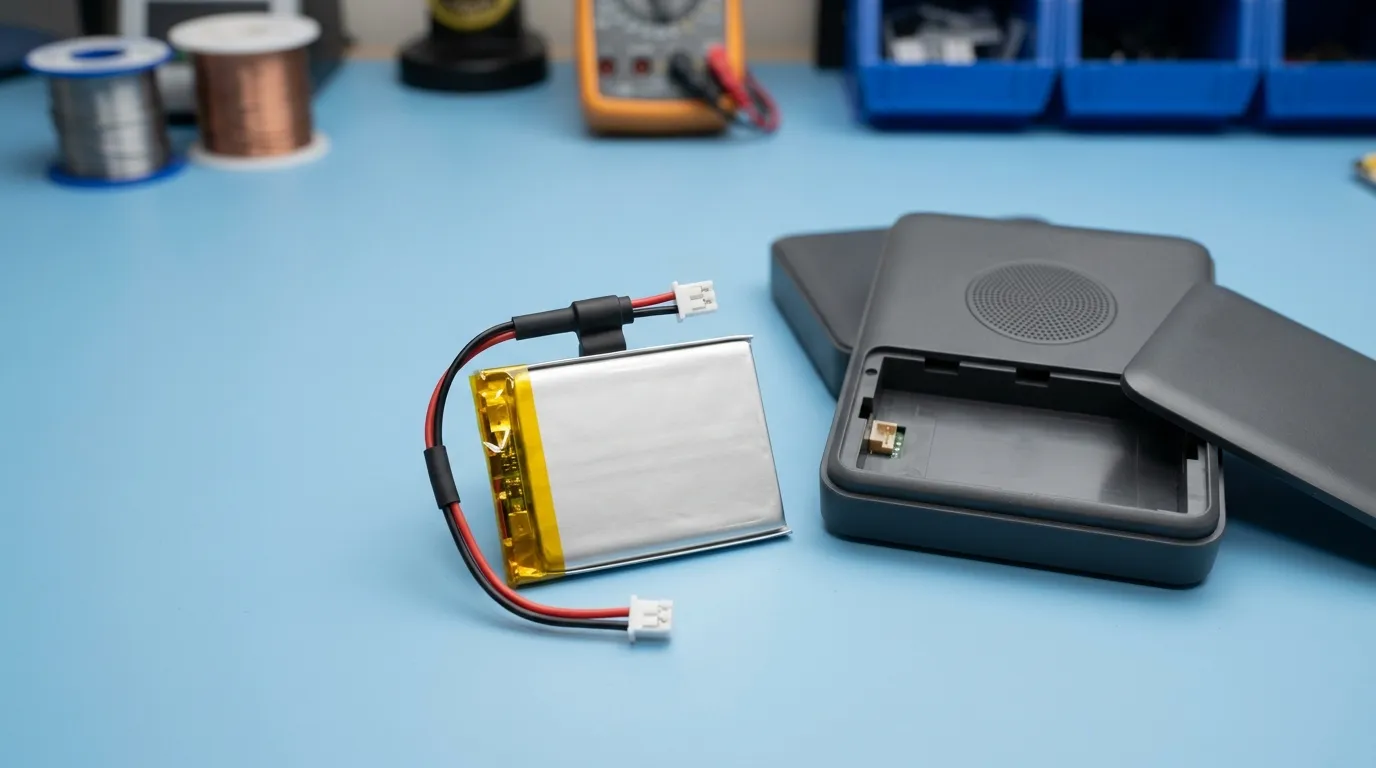
Choosing the right lithium battery for a conference speakerphone starts with understanding the device's real power consumption—not just its battery compartment size. A conference speakerphone's battery pack must be specified from the device's average and peak power draw, target operating time, usable energy in watt-hours (Wh), voltage requirements, physical space, charging method, and protection needs. Relying on milliamp-hours (mAh) alone will often lead to a pack that either underperforms in real meetings or fails to fit the enclosure.
Portable conference speakerphones combine a speaker amplifier, multiple microphones, digital signal processing (DSP), Bluetooth or USB connectivity, and status indicators—all inside a compact enclosure. Each of these subsystems draws current, and the total load changes depending on whether the device is in an active call, playing music, on mute, or in standby. That makes runtime estimation more complex than dividing a battery's rated capacity by a single current value.
This guide explains how to estimate runtime, choose between lithium-ion chemistries and form factors, define the pack's voltage and configuration, and specify the protection, charging, mechanical, and documentation requirements. It is written for product engineers, project managers, and procurement specialists who need a practical path from device requirements to a battery-pack specification.
For a broader look at custom battery options for portable audio products, see our guide to custom lithium battery for bluetooth speakers (inferred).
What Battery Does a Conference Speakerphone Use?
Most portable conference speakerphones use a rechargeable lithium-based battery pack. The pack is typically built with lithium-ion (Li-ion) or lithium-polymer (LiPo) cells because these chemistries offer a good balance of energy density, weight, and cycle life for compact consumer and business devices.
It is important to distinguish between a cell and a complete battery pack. A single cell is the basic electrochemical unit. A battery pack contains one or more cells plus protection circuitry, a connector, wiring, and usually some form of enclosure or mechanical support. When you specify a "battery" for a conference speakerphone, you are specifying a pack—not just a cell.
The exact voltage, capacity, energy, and current capability of the pack must be derived from the device's electrical design. Copying a battery specification from a general Bluetooth speaker or another audio product can lead to a pack that shuts down under peak load, runs shorter than expected, or does not fit the mechanical envelope.
How to Estimate Conference Speakerphone Runtime
Runtime is determined by usable energy in watt-hours (Wh) and the device's average power consumption during use. Milliamp-hours (mAh) are useful for comparing cells at the same voltage, but they do not account for voltage differences between packs. Two packs can have the same mAh rating yet deliver different amounts of energy if their nominal voltages differ.
Calculate Energy in Watt-Hours
The relationship is straightforward:
Wh = (mAh ÷ 1000) × nominal voltage
For example, a 3.7 V pack rated at 5000 mAh provides:
5000 mAh ÷ 1000 = 5 Ah 5 Ah × 3.7 V = 18.5 Wh
A 7.4 V pack rated at 2500 mAh also provides about 18.5 Wh, but at a different voltage and current profile. Runtime comparisons should always be made in watt-hours, not milliamp-hours.
Estimate Average Power Consumption
A conference speakerphone does not draw a constant current. Its power consumption depends on the operating state:
- Active call with speaker at moderate volume: highest draw, driven mainly by the amplifier and DSP.
- Active call with mute engaged: microphones may be muted, but the DSP, Bluetooth, and amplifier standby circuits still draw power.
- Music or media playback: similar to a Bluetooth speaker, with amplifier output dependent on volume.
- Standby or idle: lowest draw, but still includes wireless radios, status LEDs, and wake circuitry.
- Charging while in use: power is drawn from the charger, but the battery management system must handle simultaneous charge and discharge.
To estimate runtime, estimate the average power over a realistic usage cycle:
Runtime (hours) = Usable Wh ÷ Average Power (W)
Why a Pack Can Shut Down Despite Adequate Capacity
A pack's rated capacity does not guarantee full usable energy. Several factors reduce what the device can actually access:
- Voltage sag: when current demand is high, internal resistance within the cells causes the pack voltage to dip. If the voltage drops below the device's cutoff threshold, the device may shut down even though the pack still contains charge.
- Protection circuit threshold: the protection circuit may trip on overcurrent, undervoltage, or temperature before the cells are fully discharged.
- Aging: repeated charge and discharge cycles increase internal resistance and reduce capacity over time.
This is why the pack's continuous and peak current capability matters. A pack with high mAh but a low C-rate may not deliver the burst of current a speaker amplifier needs at high volume, causing voltage sag or protection trips.
Example: Estimating Runtime from a Power Draw
The following is an illustrative example, not a product specification. Assume a compact conference speakerphone with the following estimated average power draws:
| Operating State | Estimated Average Power |
|---|---|
| Active call, moderate volume | 3.0 W |
| Active call, mute engaged | 1.5 W |
| Music playback, moderate volume | 2.5 W |
| Standby | 0.2 W |
If the device is used for a mix of active calls (60%), mute (20%), and standby (20%), the average power is approximately:
(3.0 W × 0.6) + (1.5 W × 0.2) + (0.2 W × 0.2) = 1.8 W + 0.3 W + 0.04 W = 2.14 W average
With a pack offering 18.5 Wh usable, the estimated runtime would be:
18.5 Wh ÷ 2.14 W ≈ 8.6 hours
This is a calculated estimate under stated assumptions, not a certified specification. The prototype must be measured against the actual load profile before committing to a final pack specification.
Choosing the Right Chemistry and Cell Format
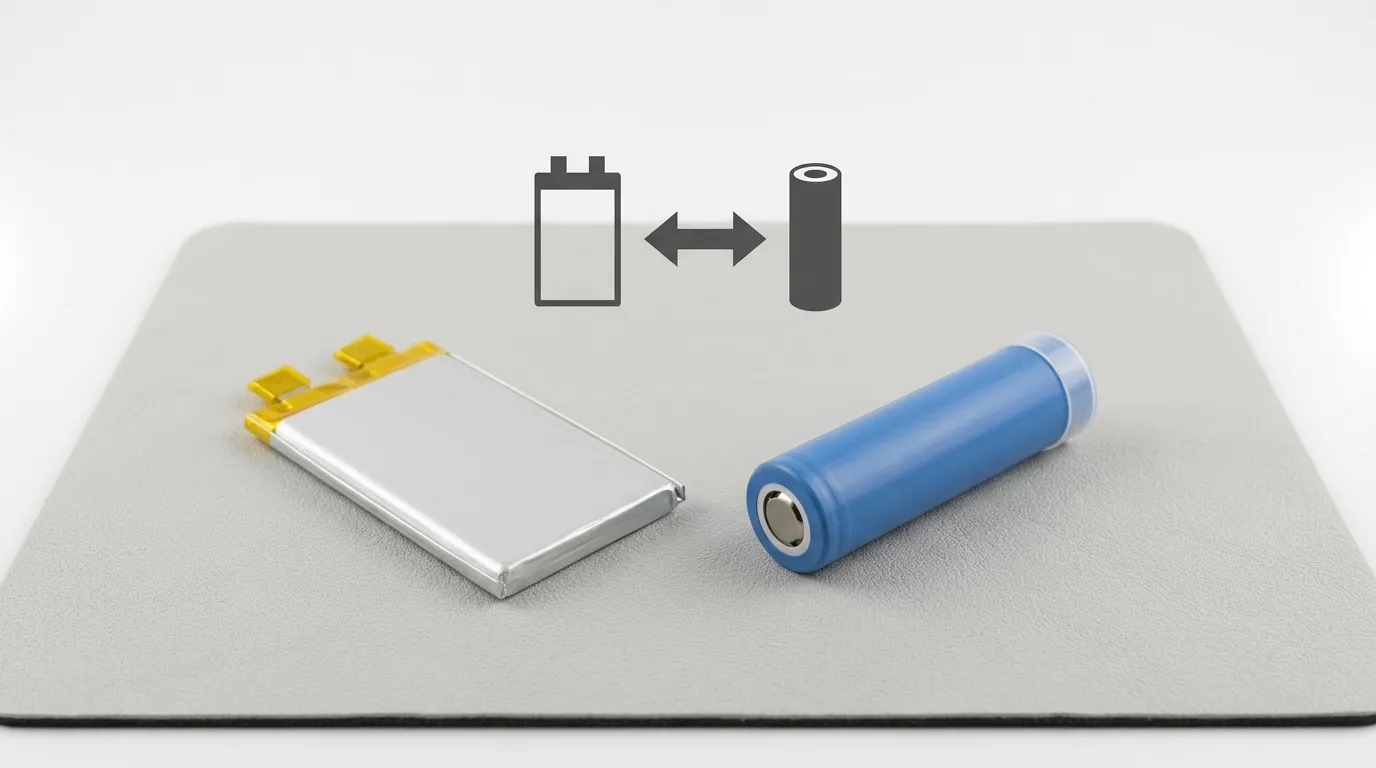
The chemistry and form factor of the cells directly affect energy density, shape flexibility, current capability, cycle life, and cost.
Li-Polymer (LiPo)
LiPo pouch cells are common in conference speakerphones because they can be manufactured in thin, custom shapes that fit compact or curved enclosures. A LiPo pack can often use the available internal volume more efficiently than cylindrical cells. However, pouch cells are more sensitive to mechanical stress and swelling, so they require proper enclosure design, compression management, and protection.
Cylindrical Cells
Cylindrical cells such as 18650 or 21700 formats offer high mechanical rigidity, consistent manufacturing quality, and often lower cost per watt-hour. They are a good choice when the enclosure can accommodate their fixed dimensions. However, cylindrical cells use space less efficiently in thin or irregularly shaped devices.
LiFePO4
Lithium iron phosphate (LiFePO4) offers a longer cycle life and a more stable thermal and safety profile than standard Li-ion chemistries. However, it has a lower nominal voltage (about 3.2 V per cell) and lower energy density, meaning a LiFePO4 pack needs more volume or weight to deliver the same Wh as a Li-ion pack. For a compact conference speakerphone, LiFePO4 is usually not the first choice unless cycle life or safety requirements are the dominant constraints.
| Chemistry / Format | Energy Density | Shape Flexibility | Typical Voltage per Cell | Best Fit |
|---|---|---|---|---|
| LiPo pouch | High | High | 3.7 V | Thin or shaped enclosures, compact devices |
| Cylindrical (18650, 21700) | Moderate to high | Low | 3.6–3.7 V | Products with fixed cylindrical space |
| LiFePO4 | Lower | Low to moderate | 3.2 V | Applications prioritizing cycle life and thermal stability |
For more on LiPo options, see our guide to the lipo battery for portable speaker and the lipo battery for bluetooth devices.
Pack Voltage, Capacity, and Configuration
The pack's nominal voltage must match the device's power architecture, including the input range of the voltage regulators, amplifier, and charging system.
Most portable audio devices operate from a single-cell Li-ion pack with a nominal voltage of about 3.6–3.7 V, or from a two-series (2S) pack with a nominal voltage of about 7.2–7.4 V. A higher pack voltage reduces current for the same power, which can reduce resistive losses and allow thinner wiring.
Series Configuration (S)
Cells connected in series add voltage. A 2S pack has twice the nominal voltage of a single cell. The maximum charge voltage also scales: a single Li-ion cell has a maximum charge voltage of about 4.2 V, while a 2S pack has a maximum charge voltage of about 8.4 V.
Parallel Configuration (P)
Cells connected in parallel add capacity and current capability while keeping the same voltage. A 2P pack has twice the capacity of a single cell and can deliver more current before hitting the same voltage sag.
Cell Ratings Versus Pack Ratings
A cell's capacity and current rating do not automatically apply to the complete pack. The pack's protection circuit, wiring, connector, and thermal design all affect the maximum continuous and peak current. Always evaluate the pack as a complete system.
| Specification | Cell Level | Pack Level |
|---|---|---|
| Nominal voltage | 3.7 V per cell | Depends on series count (e.g., 7.4 V for 2S) |
| Capacity | mAh or Ah per cell | Sum of parallel cells |
| Energy | Wh per cell | Wh of the complete pack |
| Continuous current | Cell rating under defined conditions | Limited by BMS, wiring, connector, and thermal design |
| Maximum charge voltage | 4.2 V per cell (typical Li-ion) | Scaled by series count |
For a deeper look at how the parent topic covers pack architecture for Bluetooth audio devices, refer to the custom lithium battery for bluetooth speakers (inferred) page.
Protection, BMS, and Charging Requirements
Every lithium battery pack needs protection circuitry. The level of protection depends on the pack's configuration and the device's requirements.
PCM Versus Smart BMS
A protection circuit module (PCM) provides basic protection against overcharge, over-discharge, overcurrent, short-circuit, and in many cases, overtemperature. A PCM is often sufficient for a single-series pack with no communication needs.
A battery management system (BMS) provides the same protections and may add features such as cell balancing for multi-series packs, fuel gauging, state-of-charge estimation, data logging, and communication interfaces. A smart BMS is necessary when the device must display remaining runtime, report battery health, or communicate with the host system over protocols such as SMBus, I2C, UART, CAN, or Bluetooth.
For a single-cell conference speakerphone that only needs protection, a PCM is typically sufficient. For a multi-series pack, or a device with a runtime display, a smart BMS is appropriate.
Fuel Gauge
A fuel gauge estimates the pack's state of charge and remaining runtime. Fuel gauges are useful when the device must report battery percentage or estimated hours remaining. The accuracy of a fuel gauge depends on the algorithm, the cell's characteristics, and the load profile.
Charging Requirements
The charger must match the pack's chemistry, series count, and charge voltage. Most Li-ion and LiPo cells use a constant current / constant voltage (CC/CV) charging profile: charging at a constant current until the cell reaches its maximum charge voltage, then holding that voltage while current tapers.
Conference speakerphones often charge over USB or USB-C. In that case, the device's power management must handle power-path management—allowing the device to run from the charger while simultaneously charging the battery, without exceeding the charger's current limit.
| Charging Element | Requirement |
|---|---|
| Charger voltage | Must match the pack's maximum charge voltage |
| Charging current | Must be within the cell's rated charge current |
| Charge termination | CC/CV or manufacturer-recommended termination |
| USB-C power path | Must support simultaneous use and charging safely |
Do not assume that every BMS includes balancing, fuel gauging, or communication. Confirm the exact features required for the device and specify them deliberately.
Mechanical and Thermal Integration
A battery pack must fit the device's mechanical envelope, survive normal handling, and operate without overheating.
Connector and Wiring
The connector must match the device's polarity, current rating, and mechanical retention requirements. The wiring gauge must be sufficient for the maximum current the pack will deliver, especially during peak amplifier output. A connector that is too small can introduce resistance, heat, or intermittent contact.
Enclosure Design
Pouch cells are sensitive to mechanical stress. The enclosure must prevent sharp edges from piercing the cell, provide some compression to manage swelling, and allow the pack to be inserted and removed without damaging the cells or wiring.
Thermal Management
Heat is a particular concern in a compact conference speakerphone because the speaker amplifier, wireless radios, and battery are close together. High temperatures accelerate cell aging and, in extreme cases, can trigger protection events. The pack design should account for the device's thermal path, including ventilation, heat sinks, and the location of heat-generating components.
If the product is marketed with an ingress-protection (IP) rating, the pack and its connector must be compatible with that level of protection. An IP rating is not the same as being "waterproof" in all conditions. The pack must be specified to meet the device's actual IP requirement.
Testing, Documentation, and Transport Requirements
Lithium batteries are subject to regulation in most markets. Two categories of testing are commonly confused.
Transport Testing: UN 38.3
The UN Manual of Tests and Criteria, Section 38.3 defines the transport testing requirements for lithium cells and batteries. A UN38.3 test summary identifies the tested product's model/type, Wh rating, cell configuration, and voltage/capacity ratings. This document is used to support air, sea, and ground transport of lithium batteries.
The UN38.3 test summary applies to a defined model and configuration. It is not a general company-wide document. If the pack design changes—including cell chemistry, capacity, or series/parallel configuration—the transport testing must be reviewed or repeated for the new design.
A UN38.3 test summary is not a product-safety certificate. It confirms that the product passed the transport tests specified in Section 38.3, nothing more.
Product Safety Testing: IEC 62133
IEC 62133 is a safety standard for portable sealed secondary cells and batteries. It addresses electrical, mechanical, and environmental safety requirements for rechargeable lithium-ion batteries used in portable electronic devices. A test report or certificate under IEC 62133 applies to a defined model, construction, and standard scope, as explained by testing organizations such as Intertek.
Product safety testing and transport testing serve different purposes. A buyer should understand which documents are required for the target market and the transport mode. Trade associations and testing bodies such as TÜV SÜD distinguish between transport access testing and product safety requirements.
Documentation Scope
| Document Type | Applies To | Purpose |
|---|---|---|
| UN38.3 test summary | Specific model/configuration | Lithium-battery transport documentation |
| IEC/UL test report | Specific model and standard scope | Product safety evidence |
| Datasheet/TDS | Cell or pack model | Technical specifications and limits |
| SDS/MSDS | Substance/mixture | Safety data for handling and transport |
| ISO 9001 certificate | Company quality system | Quality management, not product certification |
Company-level certifications such as ISO 9001 do not prove that a specific battery model is certified. Always ask for model-specific documentation when the application or market requires it.
What to Include in a Battery RFQ
A complete request for quotation (RFQ) helps the battery supplier provide an accurate design, quotation, and timeline. The following checklist covers the information a supplier typically needs:
| Requirement | What to Include |
|---|---|
| Load profile | Average and peak current, duration of peaks, voltage range |
| Runtime target | Target operating time at stated load conditions |
| Voltage | Nominal voltage, maximum charge voltage, cut-off voltage |
| Capacity and energy | Target mAh or Ah, target Wh |
| Mechanical space | Available dimensions, connector location, cable exit |
| Connector and wiring | Connector type, pinout, wire gauge, cable length |
| Charging | Charging method, charge current, USB-C or dedicated charger |
| BMS requirements | Protection features, balancing, fuel gauge, communication protocol |
| Temperature range | Charge, discharge, and storage temperature limits |
| Environment | Expected vibration, ingress protection, storage conditions |
| Documentation | Required datasheets, test reports, certificates, transport documents |
| Quantity and timeline | Target volume, prototype date, production start |
| Quality requirements | AQL, traceability, change control, warranty expectations |
The more complete the RFQ, the fewer clarification cycles are needed during development. For a broader set of supplier evaluation questions, see our guide on questions to ask a lithium battery pack supplier if that resource is accessible in English from your region.
Common Battery-Sizing Mistakes to Avoid
Several engineering mistakes appear repeatedly in portable audio products:
- Choosing mAh without considering voltage and load. A pack's mAh is meaningless for runtime unless the voltage and actual power draw are known.
- Ignoring peak current and voltage sag. A pack that can deliver the average current may still shut down during a bass-heavy passage or a loud alert.
- Assuming rated capacity equals usable energy. Protection thresholds, voltage sag, and aging reduce the energy the device can access.
- Selecting chemistry before checking space and thermal limits. A high-energy chemistry might not fit the enclosure or tolerate the thermal environment.
- Overlooking charger and power-path compatibility. A charger that does not match the pack's charge voltage or current limit can cause slow charging, overheating, or reduced battery life.
- Confusing transport testing with product safety testing. A UN38.3 test summary does not replace an IEC/UL product safety report.
Avoiding these mistakes reduces the risk of late design changes, failed validation, or a poor user experience.
Final Thoughts
A conference speakerphone battery is not an off-the-shelf component chosen by mAh. It is a custom pack that must be engineered around the device's power profile, mechanical space, charging interface, and market requirements. By estimating runtime from usable Wh and average power, selecting the right chemistry and format, defining the pack's voltage and configuration, and specifying the protection, charging, mechanical, and documentation needs, an OEM can move from a vague requirement to a supplier-ready specification.
If you are developing a conference speakerphone and need help defining the battery requirement, Gloflux supports custom battery design and OEM/ODM development for portable audio applications. Sending a complete RFQ with the checklist above is the most effective way to start the conversation.
For related solutions, explore our custom lithium battery for wireless microphones page if you are building a conference audio system with microphone components.
Talk to the Manufacturer
Resources & Insights

High Capacity Lithium Battery for Wearables: High-Voltage LiPo Cell Design
2026-10-19
Cylindrical Battery Packs for Laptops: 2S vs 3S vs 4S Battery Design
2026-10-19
Stage Lighting Battery Pack: Prevent Voltage Drop & LED Flicker
2026-10-19

Best Rechargeable Batteries for Smart Devices: Performance, Safety, and Selection Guide
2026-10-19


