


 Home /
Medical Replaceable Battery Pack with Smart BMS for Medical Devices


Table of Contents
- Why Battery Replacement Is Also a Data Problem
- What the Smart BMS Actually Does
- Key BMS Data for Medical Equipment
- Why a Battery Can Shut Down Before SOC Reaches Zero
- SMBus vs. I²C in a Medical Replaceable Battery Pack
- Pack-Side vs. Host-Side Fuel Gauging
- System Matching Must Start Before the Communication Protocol
- Replaceable Does Not Automatically Mean Hot-Swappable
- Connector Reliability Also Matters
- Communication Does Not Replace Safety Validation
- What OEMs Should Request From a Battery Supplier
- Engineering the Medical Replaceable Battery Pack as a Complete System
A Medical Replaceable Battery Pack must do more than supply the correct voltage and capacity. In portable patient monitors, infusion equipment, diagnostic instruments, and other battery-powered medical systems, the host may also need accurate SOC, temperature, current, battery identity, cycle history, and remaining-runtime data.
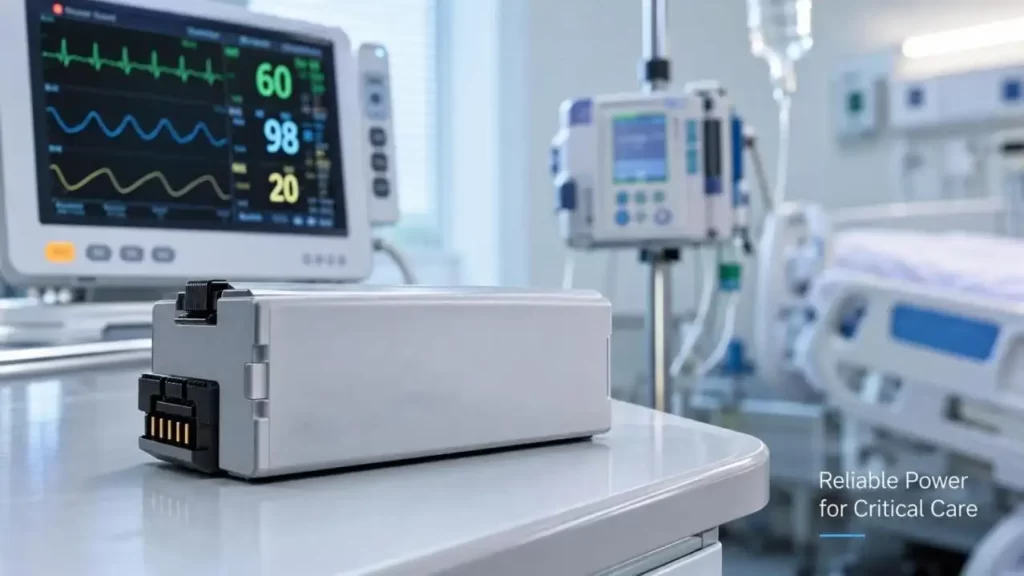
This is where SMBus, I²C, fuel gauging, and smart BMS architecture become important.
From Gloflux's perspective, a reliable Medical Replaceable Battery Pack should be engineered as part of the complete device power system—not selected as an isolated battery module.
Why Battery Replacement Is Also a Data Problem
Two battery packs can have the same nominal voltage and physical dimensions but still be electrically or digitally incompatible.
When a battery is removed, the host may lose access to:
• State of charge (SOC)
• Remaining capacity
• Battery temperature
• Full-charge capacity
• Cycle count
• Battery serial number
• Firmware or configuration ID
• Alarm and fault status
After insertion, the medical device must detect the new pack, establish communication, verify its identity, read its current operating state, and recalculate available runtime.
Therefore, Medical Replaceable Battery Pack compatibility has three layers:
| Compatibility Layer | What Must Match |
| Electrical | Voltage window, charge voltage, current, cutoff limits |
| Communication | SMBus/I²C address, command set, register map, logic level |
| Mechanical | Housing, connector, pinout, locking and insertion geometry |
A pack should not be considered interchangeable until all three are validated.
What the Smart BMS Actually Does
A basic protection board and a smart BMS are not the same thing.
A basic PCM may provide protection against:
• Overcharge
• Over-discharge
• Overcurrent
• Short circuit
A smart Medical Replaceable Battery Pack can add monitoring, calculation, communication, and traceability.
Key BMS Data for Medical Equipment
| BMS Parameter | Engineering Value |
| SOC | Remaining charge estimate |
| SOH | Battery aging indication |
| RemainingCapacity | Available Ah/mAh |
| FullChargeCapacity | Current usable capacity after aging |
| Current | Charge/discharge monitoring |
| Temperature | Thermal control input |
| Cycle Count | Service-life tracking |
| Serial Number | Traceability |
| Firmware Version | Configuration control |
A critical point is that SOC is not simply battery voltage converted into a percentage.
A reliable fuel-gauge algorithm may combine:
• Coulomb counting
• Open-circuit voltage
• Cell model data
• Temperature
• Full-charge capacity
• Internal resistance
• Previous charge/discharge history
This becomes especially important in medical equipment with variable loads.
Why a Battery Can Shut Down Before SOC Reaches Zero
As lithium cells age, usable capacity can decrease while internal resistance increases.
Under load:
Higher Internal Resistance + Higher Current → Greater Voltage Sag
If pack voltage reaches the system cutoff threshold, the equipment may shut down even when the displayed SOC still shows remaining capacity.
For a Medical Replaceable Battery Pack, runtime prediction therefore depends on more than nominal Ah.
Engineers should evaluate:
• Cell aging
• Peak load
• Continuous load
• Cutoff voltage
• Internal resistance
• Temperature
• Fuel-gauge calibration
This is one reason SOH and FullChargeCapacity are useful alongside SOC.
SMBus vs. I²C in a Medical Replaceable Battery Pack
SMBus and I²C use related two-wire communication concepts, but they should not be treated as identical.
| Design Factor | SMBus | Custom I²C |
| Battery command structure | More standardized | OEM-defined |
| Integration with smart battery systems | Strong | Highly customizable |
| Host firmware reuse | Often easier | More development required |
| Proprietary data | Moderate flexibility | High flexibility |
| Supplier migration | Potentially easier | Can create protocol lock-in |
When SMBus Makes Sense
SMBus is useful when the medical device needs a structured smart-battery interface between:
Battery → Host Controller → Charger
Typical data can include capacity, temperature, voltage, current, battery status, and manufacturer information.
When I²C Makes Sense
A custom I²C implementation can be suitable when the OEM wants:
• Device-specific registers
• Proprietary alarms
• Custom authentication
• Special service information
• Non-standard control logic
Gloflux supports configurable BMS communication including SMBus and I²C, allowing the communication strategy to follow the device architecture rather than forcing the medical device to adapt to a fixed battery protocol.
Pack-Side vs. Host-Side Fuel Gauging
Another important decision is where battery intelligence should reside.
Pack-Side Fuel Gauge
The battery stores its own:
• SOC
• Cycle count
• Aging history
• FullChargeCapacity
• Temperature history
This is particularly useful for a Medical Replaceable Battery Pack, because battery history stays with the pack when it moves between compatible equipment.
Host-Side Fuel Gauge
The medical device estimates battery condition itself.
This can reduce electronics inside the battery, but replacement becomes more difficult when a newly inserted battery has a different SOC, age, or internal resistance.
For frequently swapped batteries, pack-side intelligence generally simplifies battery-state continuity.
System Matching Must Start Before the Communication Protocol
A common design mistake is choosing SMBus or I²C first.
The correct engineering order is:
Cell Configuration → Voltage Window → Load → Charger → BMS → Communication → Connector → Housing
The Medical Replaceable Battery Pack must match:
• Maximum charge voltage
• Continuous discharge current
• Peak load
• Charger algorithm
• Low-voltage threshold
• MCU logic level
• Communication address
• Connector pinout
• Thermal limits
Gloflux smart battery platforms illustrate this multidimensional approach. Published smart-pack configurations include defined nominal voltage, capacity, maximum charge/discharge current, internal resistance, enclosure dimensions, and communication interfaces rather than capacity alone.
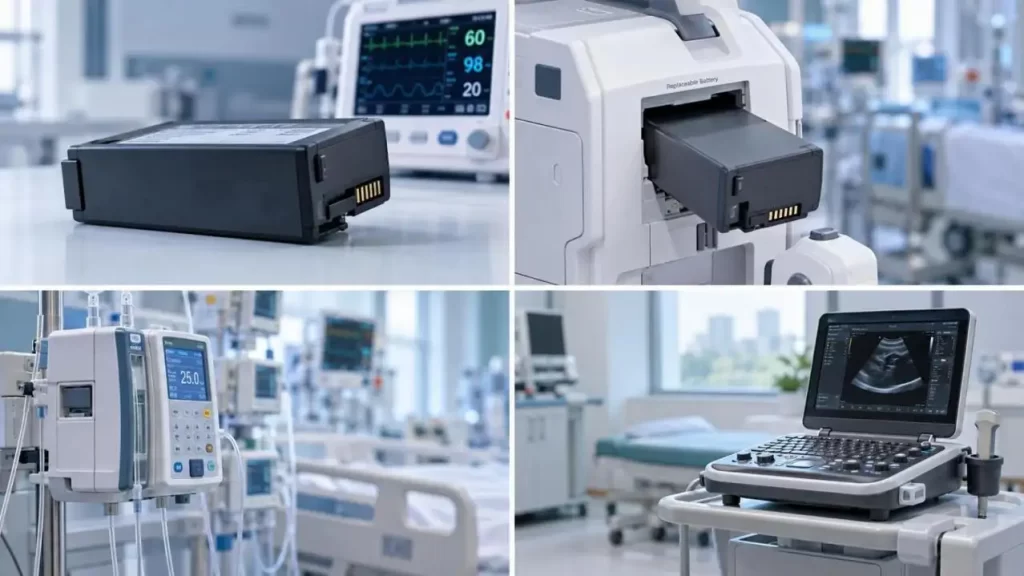
Replaceable Does Not Automatically Mean Hot-Swappable
A battery can be removable without supporting continuous operation during replacement.
A typical hot-swap sequence is:
Battery Removed → Presence Detected → Backup Power Maintained → New Pack Inserted → Communication Initialized → Battery Identified → SOC Read → Runtime Recalculated
True hot-swap capability may require:
• Dual-battery architecture
• Backup battery
• Hold-up capacitor
• Supercapacitor
• Power-path controller
• Battery-presence detection
• Coordinated firmware
SMBus or I²C only transfers data. It does not provide the energy required to keep the medical device operating during battery removal.
Connector Reliability Also Matters
Repeated replacement places mechanical and electrical stress on the battery interface.
For a Medical Replaceable Battery Pack, engineers should examine:
• Contact resistance
• Connector insertion life
• Pin alignment
• Power-first / signal-first sequencing
• Contact bounce
• Locking force
• Drop resistance
• Housing tolerance
Gloflux supports customized housings, connectors, spring contacts, and battery mechanical structures, allowing the electrical interface and enclosure to be developed around the target medical device.
Communication Does Not Replace Safety Validation
Smart communication is only one engineering layer.
Battery and device validation may involve different requirements:
| Validation Level | Typical Consideration |
| Battery safety | IEC 62133-2 |
| Transportation | UN 38.3 |
| Medical electrical equipment | IEC 60601-1 |
| Device risk management | ISO 14971 |
| Particular device requirements | Applicable IEC 60601-2-x standards |
Passing a battery-level test does not automatically make the complete medical device compliant.
The final validation plan should always consider the target device, market, battery configuration, charger, and intended use.
What OEMs Should Request From a Battery Supplier
Before approving a Medical Replaceable Battery Pack, procurement and engineering teams should review four areas.
Electrical Documentation
• Voltage and capacity
• Charge/discharge limits
• Cutoff thresholds
• Temperature range
BMS Documentation
• SMBus/I²C definition
• Address and command map
• Alarm conditions
• Firmware revision
Mechanical Documentation
• Dimensions and tolerances
• Connector drawing
• Pinout
• Latching structure
Validation Documentation
• Applicable battery test reports
• Transport documentation
• Traceability
• Engineering change control
Engineering the Medical Replaceable Battery Pack as a Complete System
The right starting question is not:
"How many mAh should the battery have?"
A better question is:
"How should the battery, BMS, host MCU, charger, connector, enclosure, and device firmware work together throughout the battery service life?"
Gloflux develops customized battery packs with configurable voltage, capacity, enclosure, connector, BMS, and communication options including SMBus and I²C. For medical-equipment projects that require replaceability, smart fuel gauging, communication, and device-specific integration, Gloflux can support development from battery architecture through pack customization and validation planning.
Learn more about custom battery solutions at Gloflux.
FAQs
Q1. Can Gloflux customize a Medical Replaceable Battery Pack for specific medical equipment?
Yes. Gloflux can develop customized battery packs around required voltage, capacity, enclosure dimensions, connector layout, BMS functions, and communication interfaces.
Q2. Can Gloflux integrate SMBus into a Medical Replaceable Battery Pack?
Yes. Gloflux supports smart BMS communication options including SMBus for applications that require battery identification, SOC data, temperature monitoring, and host communication.
Q3. Does Gloflux support I²C communication for custom medical battery projects?
Yes. I²C can be considered when the OEM requires customized registers, device-specific battery data, proprietary alarms, or other embedded communication functions.
Q4. Can Gloflux customize the BMS firmware and communication protocol?
Depending on the project requirements, Gloflux can work with customers on BMS configuration, communication logic, battery parameters, and host-side integration requirements.
Q5. What battery data can a Gloflux smart BMS provide to medical equipment?
Depending on the BMS design, available data may include voltage, current, temperature, SOC, remaining capacity, cycle count, battery status, serial information, and other diagnostic parameters.
Talk to the Manufacturer
Resources & Insights
High Capacity Lithium Battery for Wearables: High-Voltage LiPo Cell Design
2026-10-19
Cylindrical Battery Packs for Laptops: 2S vs 3S vs 4S Battery Design
2026-10-19

Stage Lighting Battery Pack: Prevent Voltage Drop & LED Flicker
2026-10-19

Best Rechargeable Batteries for Smart Devices: Performance, Safety, and Selection Guide
2026-10-19


