


 Home /
Replaceable Battery vs Embedded Battery: Engineering Trade-Offs for Device Design


Table of Contents
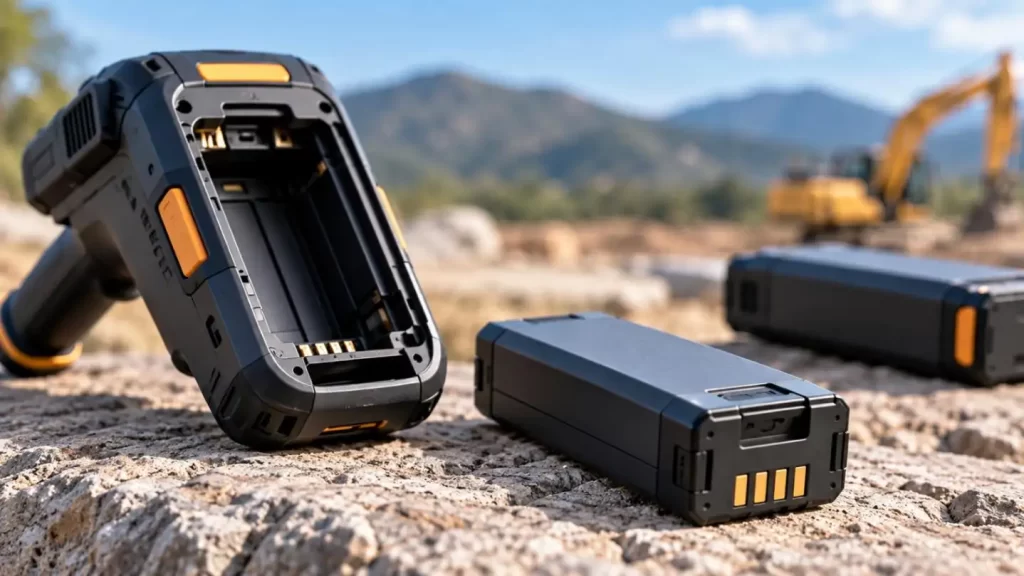
Replaceable Battery vs Embedded Battery is fundamentally a system-integration decision. A replaceable battery requires accessible electrical contacts, mechanical retention, and service clearance. An embedded battery can use a compact internal arrangement but may introduce additional disassembly requirements during maintenance.
At GLOFLUX, we evaluate both architectures against electrical loads, dimensional constraints, thermal behavior, service life, and manufacturing feasibility. Battery accessibility alone does not determine safety, energy density, or reliability.
Replaceable Battery vs Embedded Battery: Structural Differences
A replaceable battery is designed for removal through an accessible interface. An embedded battery is integrated inside the device, although it may still be replaceable by qualified technicians.
| Engineering Parameter | Replaceable Battery | Embedded Battery |
| Space Utilization | Requires housing and connector clearance | Supports compact integration |
| Electrical Interface | Repeated-mating contacts | Internal wiring or connectors |
| Mechanical Retention | Latches, guides, spring contacts | Brackets, adhesive, or fixtures |
| Waterproofing | Battery-door sealing required | Fewer external openings |
| Maintenance | Faster module replacement | Potential disassembly |
| Vibration Reliability | Contact stability critical | Mounting and wire fatigue critical |
| Manufacturing Cost | Additional interface components | Potentially lower hardware cost |
The comparison should use the complete battery assembly, including protection circuits, insulation, connectors, and mounting components—not bare-cell dimensions.
How Battery Architecture Affects Energy Density and Runtime
1. Available Volume vs. Usable Battery Energy
Nominal battery energy is calculated as:
Energy (Wh) = Nominal Voltage (V) x Capacity (Ah)
Real-world runtimes are dependent upon a variety of factors such as discharge efficiency, load, cutoff voltage, and temperature.
There are advantages to a modular design. Space can be allocated for connectors, protective housings, and retention mechanisms. Custom shapes and sizes can be filled with battery cells.
When comparing Replaceable Battery modules and Embedded Batteries, consider the following:
• Energy density (Wh/kg, Wh/L)
• Continuous and peak discharge
• Voltage sag
Equal mAh ratings do not equal equal battery capacities, and more importantly, do not equal equal run times, when considering differing load conditions.
2. Electrical Contact Resistance
Batteries with a removable interface have a repeatable contact insertion interface and are prone to localized heat.
P = I²R
When contact resistance is 20 mΩ and there is a load current of 5A.
There are a few reasons why the resistance may increase, such as oxidation, micro-motion, and vibration.
It is necessary to examine the following:
• Contact resistance before and after cycling
• The endurance of mating connector cycles
• Contact force and terminal alignment
• Peak current voltage drop
• Contact interruption due to vibration
3. Dimensional Tolerance and Assembly Fit
Precision in assembly directly impacts the reliability of battery installation.
For replaceable modules, engineers must also control the tolerance of housings, connector positioning, locking engagement and contact compression.
A basic clearance assessment is as follows:
Minimum Clearance = Minimum Cavity Dimension - Maximum Battery Dimension
In the case of negative clearance, we cannot rule out potential interference; however, the final assessment is determined by the fit and comliancy of the components.
GLOFLUX's rechargeable AA batteries provide us with a reference for dimensions:
| Parameter | Specification |
| Models | 2AN-100 / 2AN-70 |
| Product Dimensions | 14 × 50 ± 0.5 mm |
| Product Weight | 19 ± 0.5 g |
| Rated Voltage | 1.5 V |
The specifications above are for the specified models only, and not for all of GLOFLUX's manufacturing tolerances for lithium batteries.
We evaluate and verify design acceptance criteria against approved drawings, clearances of connectors, enclosures and allowable expansion of batteries for custom designs.
4. Protection Circuit Requirements
Both battery architectures require protection appropriate to their cell chemistry and operating conditions.
At GLOFLUX, our custom battery engineering covers:
• Overcharge and over-discharge protection
• Overcurrent and short-circuit protection
• NTC-based temperature monitoring
• Protection-board and BMS configuration
• Connector and charging-interface matching
Replaceable modules may additionally require polarity protection, controlled connection sequencing, and battery identification.
Hot swapping is not equivalent to battery replacement. Uninterrupted operation requires suitable power-path management or backup energy storage.
5. TBA Design and Enclosure Sealing
Fully sealed enclosures and embedded batteries can lead to thermal buildup. Connectors and housings need to include thermal considerations with the use of replaceable batteries.
Thermal validation should measure:
• Cell surface temperature under maximum load
• Connector temperature rise
• BMS component temperature
• Charging behavior at temperature limits
• Heat distribution after prolonged operation
Neither architecture is inherently waterproof. Sealing performance must be verified at the complete-device level.
Replaceable Battery vs Embedded Battery: Lifecycle Cost and Applications
Initial procurement cost is only one selection criterion.
Total Ownership Cost = Initial Cost + Maintenance + Downtime + End-of-Life Cost
Replaceable modules can reduce service downtime and extend equipment use when battery degradation precedes device obsolescence.
Embedded batteries may reduce certain enclosure components but increase repair complexity.
| Application | Typical Design Choice | Main Requirement |
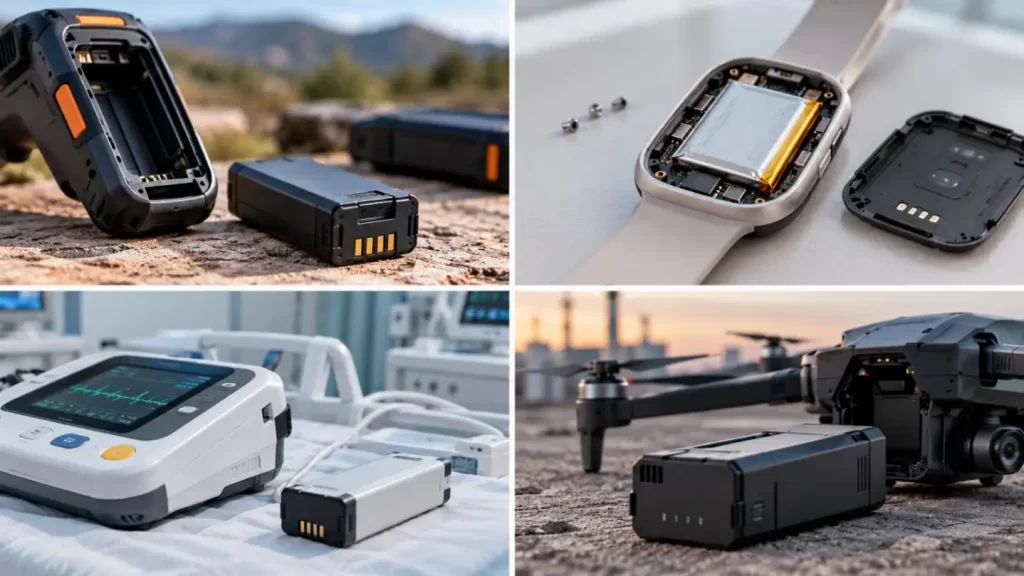
| Smart Wearables | Embedded | Compact geometry |
| Industrial Scanners | Replaceable | Field replacement |
| Portable Medical Devices | Application-dependent | Safety and power continuity |
| Beauty Devices | Application-dependent | Sealing and serviceability |
| Mobile Robotics | Often replaceable | Operational availability |
| IoT Sensors | Application-dependent | Service life and environmental exposure |
Environmental benefits also depend on device longevity, replacement frequency, spare-part availability, and recycling—not battery accessibility alone.
Safety Testing and EU Battery Requirements
Replaceable Battery vs Embedded Battery decisions must account for destination-market regulations.
Relevant references:
• IEC 62133-2: Safety of portable rechargeable lithium cells and batteries
• UN 38.3: Lithium battery transportation testing
• Mechanical qualification: Drop, shock, vibration and connector endurance testing.
• Electrical qualification: Capacity testing, protection thresholds testing, insulation testing, load testing.
Article 11 of EU Regulation 2023/1542: From 18 February 2027, requirements relating to the removability and replaceability of specified categories of batteries will enter into force, with derogations and exceptions.
An embedded design is not always prohibited, and will depend on the safety features and replacement mechanism of the product.
GLOFLUX Manufacturing Capabilities and OEM/ODM Validation
At GLOFLUX, we have the capability to provide customized LiPo cells, and customized lithium-ion packs, BMS and connectors integration and structural integration.
Our manufacturing infrastructure includes:
| Manufacturing Capability | GLOFLUX Data |
| Manufacturing Facility | 30,000 m² |
| Annual Production Capacity | Over 100 million batteries |
| Quality Control | 60+ inspection procedures |
| Development Support | Prototyping through mass production |
For custom battery projects, engineering validation should link dimensional inspection with capacity testing, internal-resistance measurement, thermal assessment, and protection-circuit verification.
Selecting the Right Battery Architecture
Before finalizing Replaceable Battery vs Embedded Battery, OEM engineers should specify:
• Voltage, capacity, continuous and peak current
• Maximum battery dimensions and mechanical clearances
• Connector, charging, and BMS requirements
• Operating temperature and environmental exposure
• Service-life targets and replacement frequency
• Certification, testing, and inspection requirements
At GLOFLUX, we help OEM and ODM customers translate these requirements into practical lithium battery designs. Explore our custom battery solutions to evaluate the electrical, mechanical, and manufacturing considerations for your next device.
FAQs
Q1. Does GLOFLUX offer both replaceable and embedded batteries?
Yes. GLOFLUX provides OEM/ODM lithium battery solutions for removable battery modules and integrated battery packs, customized to device requirements.
Q2. Can GLOFLUX customize battery dimensions for compact devices?
Yes. We customize LiPo battery thickness, width, length, capacity, and configuration according to available installation space.
Q3. Can GLOFLUX customize connectors for replaceable battery packs?
Yes. We support custom connectors, wiring, battery enclosures, and mounting structures to match device interfaces.
Q4. Does GLOFLUX provide customized BMS protection?
Yes. Our BMS solutions support overcharge, over-discharge, overcurrent, and short-circuit protection, with configurations tailored to the application.
Q5. Can GLOFLUX integrate NTC temperature sensors?Yes. We support NTC integration for battery temperature monitoring and compatibility with the device's charging and protection systems.
Talk to the Manufacturer
Resources & Insights
High Capacity Lithium Battery for Wearables: High-Voltage LiPo Cell Design
2026-10-19
Cylindrical Battery Packs for Laptops: 2S vs 3S vs 4S Battery Design
2026-10-19
Stage Lighting Battery Pack: Prevent Voltage Drop & LED Flicker
2026-10-19

Best Rechargeable Batteries for Smart Devices: Performance, Safety, and Selection Guide
2026-10-19


