


 Home /
 Custom High-Power 7.4V/11.1V 1200mAh 10C 14500 Li-Ion Battery Pack for Electric Soft-Dart Blasters and Water Guns


Table of Contents
- What Is a Custom 14500 Li-Ion Battery Pack?
- Choosing Between 7.4V and 11.1V
- Why 10C Discharge Performance Matters
- Benefits of the 1200mAh Capacity
- Why Use 14500 Cells for Electric Toys?
- Customization Options for OEM Projects
- Battery Protection and Charging Safety
- Typical Applications
- Conclusion
- Frequently Asked Questions
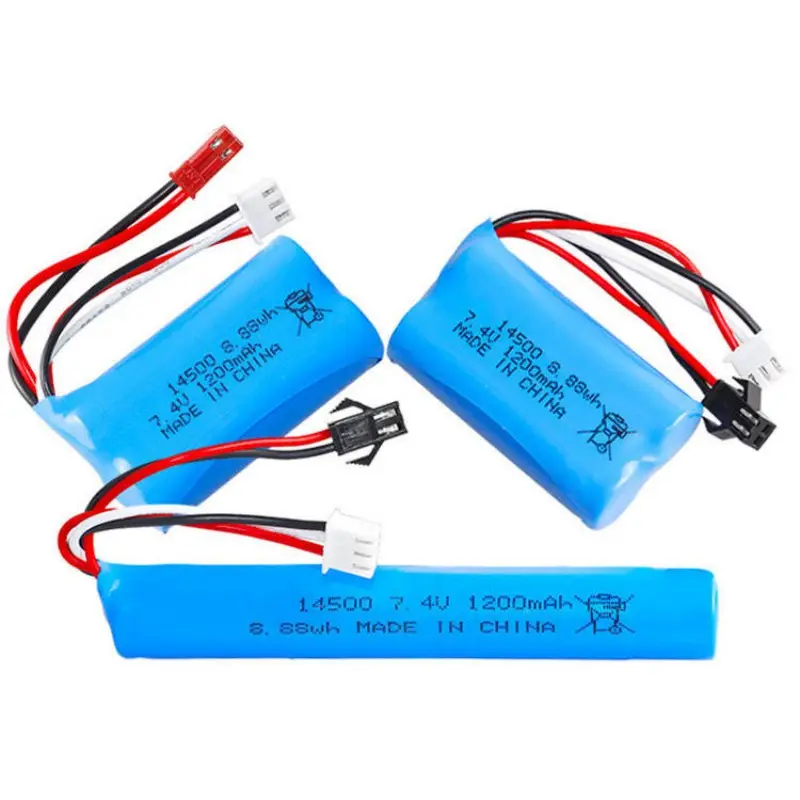
A Custom 14500 Li-Ion Battery Pack provides a compact and rechargeable power solution for electric soft-dart blasters, electric water guns, motor-driven launchers, and other recreational electric toys. These products often require more than basic battery capacity. Their motors and pumps may draw a relatively high current during startup, rapid firing, or continuous operation.
A properly designed 7.4V or 11.1V 1200mAh 10C battery pack can deliver responsive motor performance while fitting into a narrow battery compartment. However, voltage, capacity, discharge rate, dimensions, connector type, wiring, and charging design must all be matched to the finished product.
For toy manufacturers and OEM developers, customization is especially important because different toy models may use different internal structures, motor specifications, connectors, and operating modes.
What Is a Custom 14500 Li-Ion Battery Pack?
A 14500 lithium-ion cell is a small cylindrical rechargeable battery with a diameter similar to a standard AA battery. However, it uses lithium-ion chemistry and has different voltage, charging, and protection requirements.
Multiple 14500 cells can be connected to create different battery pack configurations. A 7.4V pack normally uses two cells connected in series, while an 11.1V pack generally uses three cells connected in series.
The final battery pack may also include wires, connectors, insulation, protective wrapping, structural supports, and an optional protection circuit. These components must be selected according to the current demand, installation space, and safety requirements of the electric toy.
A custom battery pack allows these specifications to be adjusted around the equipment rather than forcing the product designer to use an unsuitable standard battery.
Choosing Between 7.4V and 11.1V
Voltage directly affects the operation of the toy’s electrical system. A 7.4V battery is often used in compact products with moderate motor requirements. It can provide a practical balance of power output, weight, size, and runtime.
An 11.1V battery provides a higher operating voltage and may support faster motor response in equipment specifically designed for it. However, it also places greater electrical and mechanical demands on the motor, controller, switches, wiring, and other components.
A higher-voltage battery should not be installed simply to increase performance. Using an 11.1V battery in a product designed only for 7.4V may cause overheating, premature motor wear, controller failure, or damage to internal wiring.
Before selecting the voltage, the battery supplier should receive information about the motor rating, normal working current, startup current, control board, charging system, and expected operating mode.
Why 10C Discharge Performance Matters
Electric toy blasters and water guns frequently require a short burst of current when the trigger is activated. A motor may draw significantly more current during startup than during steady operation.
The discharge rate describes how quickly a battery can supply current relative to its rated capacity. A 1200mAh 10C battery is designed for applications that require stronger current delivery than a standard low-discharge battery of the same capacity.
Appropriate discharge performance can help support:
- Rapid motor startup
- Responsive trigger operation
- Consistent firing cycles
- Stable water-pump pressure
- Reduced voltage drop under load
- Reliable operation during repeated use
The C-rate should not be evaluated alone. The cells, protection board, nickel strips, wires, soldering points, and connector must all support the required current. A high-rate battery may still perform poorly when paired with an undersized wire or low-current connector.
Buyers should confirm both the continuous current and short-duration peak current with the battery manufacturer.
Benefits of the 1200mAh Capacity
The 1200mAh capacity offers a practical balance for compact recreational toys. It can provide useful operating time without making the battery excessively large or heavy.
Actual runtime depends on the product rather than capacity alone. Important factors include:
- Motor or pump power
- Average working current
- Frequency of trigger activation
- Duration of continuous use
- Lighting and sound functions
- Control board consumption
- Operating temperature
- Battery age and charging condition
For example, a water gun with a continuously running high-output pump may consume energy faster than a soft-dart blaster used intermittently. Product developers should test the battery in the actual equipment rather than estimating runtime only from the capacity label.
Why Use 14500 Cells for Electric Toys?
The compact cylindrical shape of 14500 cells is suitable for narrow handles, stocks, tubes, and limited battery compartments. Their small size also gives designers more flexibility when arranging cells inside irregular product structures.
Depending on the available space, the cells may be arranged in a straight line, triangular layout, side-by-side structure, or another customized configuration.
Compared with a larger cylindrical battery, a 14500 pack may reduce overall size and weight. This can improve product balance and handling, particularly in handheld electric toys.
The battery compartment must still allow enough room for wiring, connectors, insulation, protective materials, and safe installation. Cells should not be compressed, punctured, bent, or placed against sharp plastic or metal parts.
Customization Options for OEM Projects
A custom battery solution can be developed according to the product’s electrical and mechanical requirements. Common customization options include:
- 7.4V or 11.1V configuration
- 1200mAh or alternative capacity
- Required continuous and peak current
- Cell arrangement and pack dimensions
- Connector type and polarity
- Wire length and wire gauge
- Heat-shrink wrapping or protective casing
- Protection circuit specifications
- Battery labels and warning information
- Charging cable or charger options
- Individual or bulk packaging
Before sample development, the buyer should provide complete technical information. This normally includes the battery compartment dimensions, product voltage, normal current, peak current, connector image or model, expected runtime, charging method, operating temperature, and target sales market.
Clear information can reduce repeated sample revisions and help the battery manufacturer recommend a more suitable pack structure.
Battery Protection and Charging Safety
Lithium-ion batteries require a compatible charging system. A 7.4V pack and an 11.1V pack use different charging voltages, so they must not share an incompatible charger.
Depending on the application, the battery pack may include protection against overcharging, over-discharging, excessive current, and short circuits. The protection circuit must allow the motor’s normal startup current. If its current limit is too low, the battery may shut down whenever the trigger is activated.
Manufacturers should provide instructions for charging, storage, inspection, and replacement. Batteries that are swollen, punctured, leaking, excessively hot, or physically damaged should not be charged or used.
Typical Applications
Custom 14500 lithium-ion battery packs can be developed for:
- Electric soft-dart blasters
- Rechargeable electric water guns
- Gel ball blasters
- Motor-driven toy launchers
- Electric shooting toys
- Remote-controlled recreational devices
- Replacement battery systems
- Customized entertainment products
Each application should be evaluated independently because products with the same nominal voltage may have different current, size, connector, and charging requirements.
Conclusion
A Custom 14500 Li-Ion Battery Pack can provide compact size, stable discharge performance, and flexible integration for electric toy blasters and water guns.
The 7.4V and 11.1V options allow the battery to support different electrical systems, while the 1200mAh capacity and 10C discharge capability provide a useful balance of runtime and responsive power delivery.
For reliable OEM production, the battery should be designed according to the actual motor current, installation space, connector, charging system, and operating conditions. Customizing the complete battery pack—not only the cells—helps improve compatibility, performance, and long-term product reliability.
Frequently Asked Questions
1. Can I replace a 7.4V battery with an 11.1V battery?
Not unless the motor, controller, wiring, switches, and charging system are designed for 11.1V operation. Using excessive voltage may damage the equipment.
2. What does 10C mean on a 1200mAh battery?
The 10C rating describes the battery’s discharge capability relative to its capacity. Buyers should also confirm the specified continuous and peak current with the manufacturer.
3. Can the shape of a 14500 battery pack be customized?
Yes. The cells can be arranged in different configurations according to the battery compartment, provided the design includes sufficient insulation, wiring space, and mechanical protection.
4. Which information is needed to customize the battery?
Provide the required voltage, normal current, peak current, compartment dimensions, connector details, wire length, expected runtime, charging method, and operating temperature.
5. Does the battery pack include a protection circuit?
A protection circuit can be added according to the application. Its current rating must be selected carefully so it protects the battery without interrupting normal motor startup.
Talk to the Manufacturer
Resources & Insights
High Capacity Lithium Battery for Wearables: High-Voltage LiPo Cell Design
2026-10-19
Cylindrical Battery Packs for Laptops: 2S vs 3S vs 4S Battery Design
2026-10-19
Stage Lighting Battery Pack: Prevent Voltage Drop & LED Flicker
2026-10-19
Best Rechargeable Batteries for Smart Devices: Performance, Safety, and Selection Guide
2026-10-19


