


 Home /
 Rechargeable 450mAh 13310 Li-Ion Battery for Electric Toothbrushes and Beauty Devices


Table of Contents
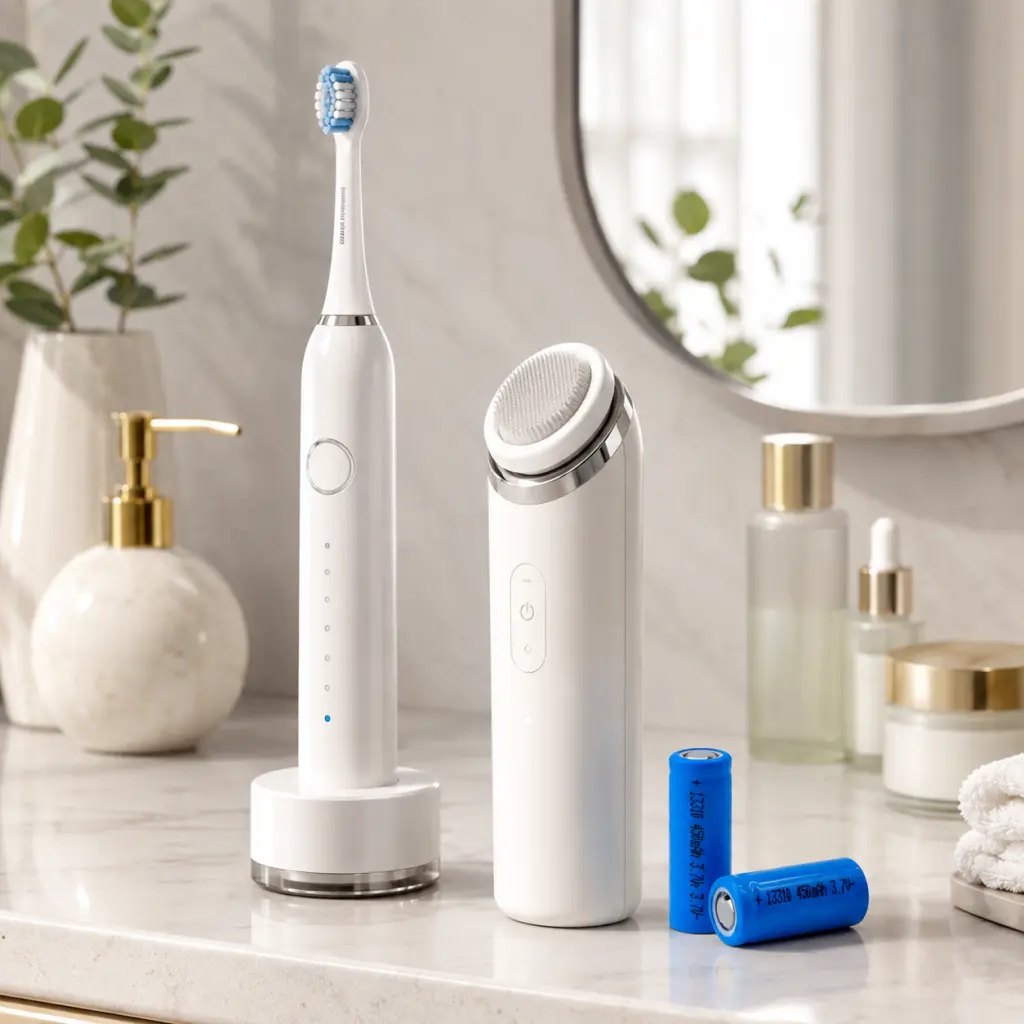
Compact personal care products require batteries that can fit inside narrow enclosures while still delivering reliable power for motors, vibration systems, LED indicators, sensors, and control circuits. Electric toothbrushes and portable beauty devices are good examples. Their slim handles leave limited space for internal components, making battery size, capacity, discharge performance, and charging compatibility important design considerations.
A rechargeable 450mAh 13310 lithium-ion battery provides a practical power solution for electric toothbrushes, facial cleansing tools, beauty instruments, and other compact personal care equipment. Its miniature cylindrical format supports space-efficient installation, while its rechargeable design helps manufacturers create portable products that are convenient for repeated daily use.
What Is a 13310 Lithium-Ion Battery?
The model number 13310 generally refers to the approximate dimensions of the cylindrical cell. It is typically around 13 mm in diameter and 31 mm in length, although the final size may vary slightly depending on the cell manufacturer, terminal structure, protective sleeve, tabs, wires, or added protection circuit.
This small cylindrical construction makes the battery suitable for products with narrow internal compartments. Compared with larger cylindrical cells, a 13310 battery requires less installation space and can help reduce the overall size and weight of the finished device.
The 450mAh capacity provides an appropriate energy reserve for low-power personal care products. The actual operating time depends on motor efficiency, vibration intensity, working modes, standby current, charging condition, and the efficiency of the electronic control system.
Lithium-ion versions commonly use a nominal voltage of approximately 3.7V, but the exact electrical specification should always be confirmed before product integration.
Why the 13310 Battery Fits Electric Toothbrushes
Electric and sonic toothbrushes usually have long, narrow handles that must contain a motor, drive shaft, charging coil or port, control board, switch, seals, and battery. Every component must fit within a limited internal diameter.
The compact 13310 battery is well suited to this type of structure. Its cylindrical form can be positioned vertically inside the toothbrush handle and secured with brackets, foam, adhesive, or a customized battery compartment.
During operation, the battery supplies power to the motor that creates oscillating, rotating, or sonic brushing movement. Stable voltage output helps the toothbrush maintain consistent brushing intensity instead of slowing down significantly as the battery discharges.
A 450mAh capacity can support repeated brushing sessions between charges, depending on the motor load and brushing program. Products with several speed levels, pressure sensors, timers, Bluetooth functions, displays, or strong vibration modes may consume more power and require detailed runtime testing.
Applications in Compact Beauty Devices
The same battery format can also be used in small rechargeable beauty products. These devices often require a lightweight power source that can be installed inside a handheld enclosure without reducing portability.
Suitable applications may include:
- Facial cleansing brushes
- Mini facial massagers
- Electric eyebrow trimmers
- Portable skincare instruments
- Eye-care massagers
- Compact exfoliating tools
- Small LED beauty devices
- Rechargeable grooming equipment
Beauty devices may use motors, vibration modules, LED lights, heating elements, sensors, or microcurrent functions. Each feature creates a different electrical load. Manufacturers should therefore evaluate the battery according to the complete device rather than selecting it by capacity alone.
For products with heating or high-power output, a 450mAh miniature cell may not provide sufficient runtime or discharge current. The battery supplier should review the continuous current, peak current, operating time, and available installation space before confirming suitability.
Rechargeable Design for Daily Convenience
Rechargeable batteries improve the convenience of electric toothbrushes and beauty devices by eliminating frequent disposable battery replacement. Users can recharge the product through a charging dock, magnetic connector, USB port, wireless charging coil, or dedicated adapter.
A single-cell lithium-ion battery requires a compatible charging circuit that controls charging voltage and current. The circuit should stop charging correctly when the cell reaches its specified upper voltage limit and should prevent excessive discharge during use.
The selected charging current affects charging time, temperature rise, and battery service life. A higher charging current may reduce charging time, but it must remain within the cell manufacturer’s recommended range.
Charging performance should be tested inside the complete product enclosure. A small sealed handle may retain heat differently from an open laboratory environment, especially in waterproof toothbrushes or tightly enclosed beauty devices.
Protection and Safety Considerations
Battery safety is especially important in devices used near the face, mouth, skin, or water. A suitable protection circuit can help prevent overcharge, over-discharge, overcurrent, and short circuits.
Protection parameters must match the actual product load. Electric toothbrush motors can create a temporary startup current, while beauty devices may generate current peaks when switching modes. If the overcurrent threshold is too low, the product may shut down during normal use.
Mechanical protection is equally important. The battery should not be crushed, bent, punctured, or placed under excessive pressure inside the enclosure. Insulation should separate the battery terminals from metal parts, circuit boards, and motor housings.
Electric toothbrushes and many facial cleansing tools are exposed to water or moisture. The finished product should use appropriate sealing, waterproof structures, drainage control, and charging-port protection. The battery itself should not be directly exposed to water, toothpaste, skincare liquids, oils, or cleaning chemicals.
Customization for OEM Projects
The 450mAh 13310 lithium-ion battery can be customized to match different electric toothbrush and beauty-device designs. Common customization options include:
- Nickel tabs and terminal direction
- Wire length and wire gauge
- Connector model and polarity
- Heat-shrink sleeve or insulating cover
- Protection circuit parameters
- Battery labels and branding information
- Foam padding and fixing materials
- Capacity, current, and charging requirements
Before battery development begins, the OEM customer should provide the battery compartment dimensions, device voltage, continuous current, peak current, expected runtime, charging method, connector details, operating temperature, and waterproof requirements.
A product drawing, battery-compartment sample, or 3D model can help the battery supplier confirm whether the cell and added components will fit correctly.
Quality Control and Testing
Reliable battery performance depends on consistent raw cells and controlled assembly. Incoming cells should be checked for voltage, capacity, internal resistance, dimensions, and appearance.
During production, manufacturers should inspect tab welding, wire connections, polarity, insulation, sleeve condition, and protection-board installation. Finished batteries may undergo capacity testing, charge and discharge testing, protection-function testing, dimensional inspection, and connector verification.
The battery should also be tested inside the final electric toothbrush or beauty device. Product-level testing can identify issues related to motor startup, vibration stability, runtime, charging temperature, standby consumption, waterproof structure, and mechanical fit.
Transportation documentation and market compliance requirements should be confirmed according to the destination country, shipping method, and finished product category.
Conclusion
The rechargeable 450mAh 13310 lithium-ion battery offers a compact power solution for electric toothbrushes, facial cleansing devices, beauty instruments, and other small personal care products. Its miniature cylindrical structure supports installation inside narrow handles and lightweight enclosures, while its rechargeable performance improves daily convenience.
Successful battery integration requires more than matching the dimensions and capacity. Manufacturers should also confirm discharge current, charging compatibility, protection settings, mechanical structure, waterproof design, operating temperature, and expected runtime. With proper customization and product-level testing, the 13310 battery can support stable performance and reliable operation in modern cordless personal care equipment.
Talk to the Manufacturer
Resources & Insights
High Capacity Lithium Battery for Wearables: High-Voltage LiPo Cell Design
2026-10-19
Cylindrical Battery Packs for Laptops: 2S vs 3S vs 4S Battery Design
2026-10-19
Stage Lighting Battery Pack: Prevent Voltage Drop & LED Flicker
2026-10-19
Best Rechargeable Batteries for Smart Devices: Performance, Safety, and Selection Guide
2026-10-19


