


 Home /
 Lithium Battery for Smart Thermostats: Low-Power OEM Selection


Table of Contents
- What Type of Battery Does a Smart Thermostat Use?
- Define the Thermostat Load Profile Before Choosing a Battery
- Lithium Battery Chemistry and Form Factor for a Smart Thermostat
- Voltage, Capacity, Energy, and Pack Configuration
- Protection, Charging, and C-Wire Architecture
- Mechanical Integration: Connector, Enclosure, Insulation, and Thermal Path
- Validation, Transport, and Compliance Documentation
- Thermostat Battery Supplier RFQ Checklist
- Frequently Asked Questions
- Bringing the Specification to a Battery Manufacturer
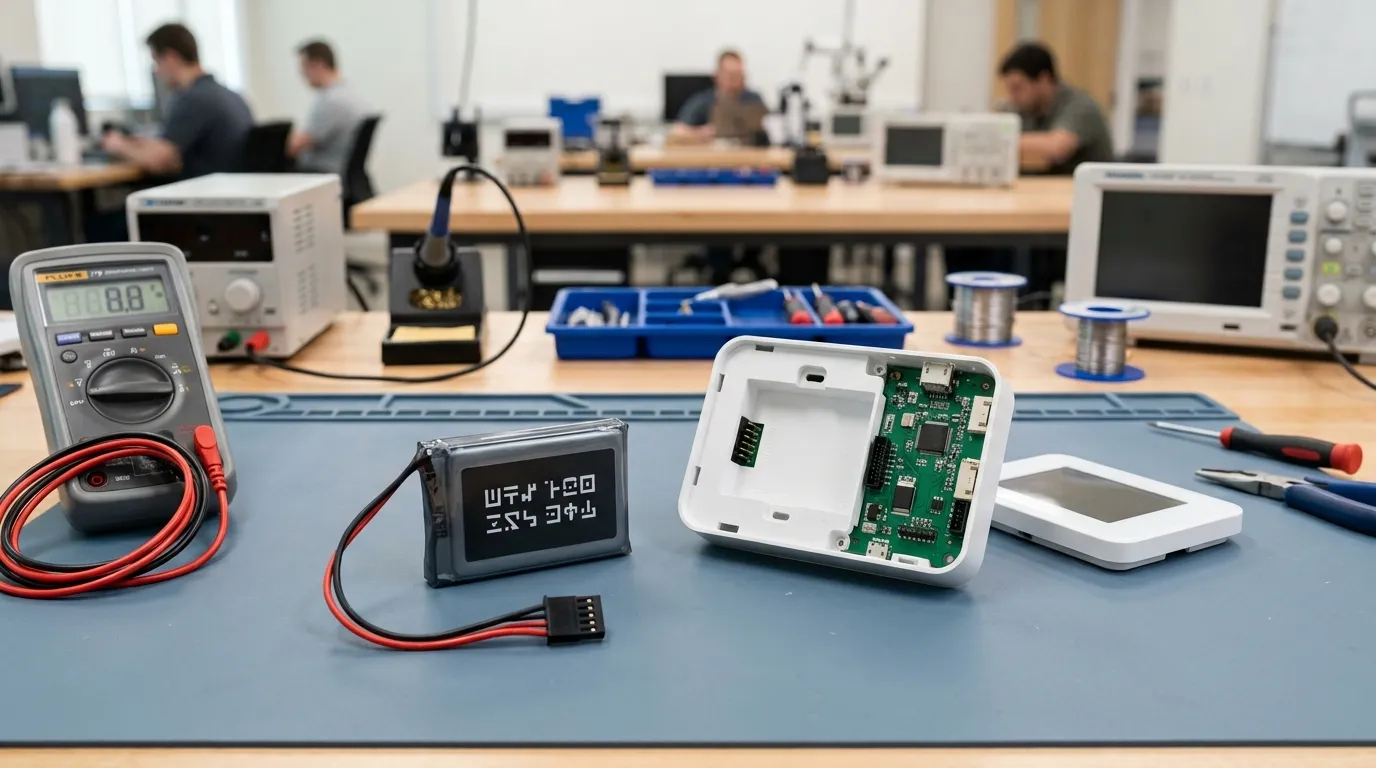
A lithium battery for a smart thermostat is not a one-size-fits-all component. The correct solution—whether a primary cell, a rechargeable lithium-ion or lithium-polymer pack, or a backup battery in a C-wire-powered design—depends entirely on the thermostat's measured load profile, physical enclosure, and power architecture.
This guide is written for product engineers and OEMs who need to translate a thermostat's standby and transmission behavior into a lithium battery specification, select an appropriate chemistry and pack architecture, and document the requirements correctly for a battery supplier. Consumer replacement questions for specific thermostat brands are a separate topic and are not covered here.
For a broader view of custom lithium battery options across smart-home devices, see our custom lithium ion battery for smart home devices guide.
What Type of Battery Does a Smart Thermostat Use?
Smart thermostats generally fall into one of three power architectures:
- Primary cells (AA, AAA, or coin cells): Non-rechargeable batteries that power the device until depleted. Common in simpler or consumer-replaceable designs.
- Built-in rechargeable lithium battery packs: Li-ion or LiPo packs that are recharged by the device or a dedicated charger. These are increasingly common in compact, connected thermostats.
- C-wire-powered designs with battery backup: The thermostat draws continuous power from the HVAC system's common wire, and the battery serves as a reserve during power interruptions.
The distinction matters because it determines whether the battery must handle the full average load, whether it needs a charging circuit, and which protection features are mandatory.
Define the Thermostat Load Profile Before Choosing a Battery
The single most important step in battery selection is defining the thermostat's electrical load over time. Without a load profile, any capacity, current, or runtime figure is a guess.
- Measure standby current. This is the current drawn continuously by the microcontroller, sensors, and display when the device is idle. For many smart thermostats, standby dominates total energy consumption.
- Measure average current over a representative duty cycle. Include periodic sensor reads, display updates, and short radio wake-ups.
- Identify peak current events. Wi-Fi transmission, backlight illumination, or actuator/relay drive can create short, high-current pulses that a battery must supply without excessive voltage sag.
- Determine the duty cycle. How often do the peak events occur, and for how long?
- Define the operating temperature range. A thermostat mounted near an HVAC vent or in an unconditioned space may see wider temperature swings than a typical indoor device.
Example Capacity Calculation
Assume a thermostat has:
- A standby current of 30 µA at 3.7 V.
- A Wi-Fi transmission event of 150 mA for 2 seconds, occurring every 5 minutes.
- A target of 12 months of operation before recharge or replacement.
First, calculate the average current:
- Wi-Fi duty cycle = 2 seconds / 300 seconds = 0.0067 (0.67%).
- Average Wi-Fi current = 150 mA × 0.0067 = approximately 1 mA.
- Total average current = 0.03 mA + 1 mA = approximately 1.03 mA.
Then calculate the required capacity in mAh:
- 1.03 mA × 24 hours × 365 days = approximately 9,023 mAh over one year.
Expressed as energy:
- 9,023 mAh × 3.7 V = approximately 33.4 Wh.
This is a substantial energy requirement. In practice, many Wi-Fi-connected thermostats are C-wire powered, with the battery serving only as backup. A battery-only design with frequent Wi-Fi transmission would need either a large pack or a more aggressive power management strategy. The example illustrates why the load profile must be measured rather than assumed.
Lithium Battery Chemistry and Form Factor for a Smart Thermostat
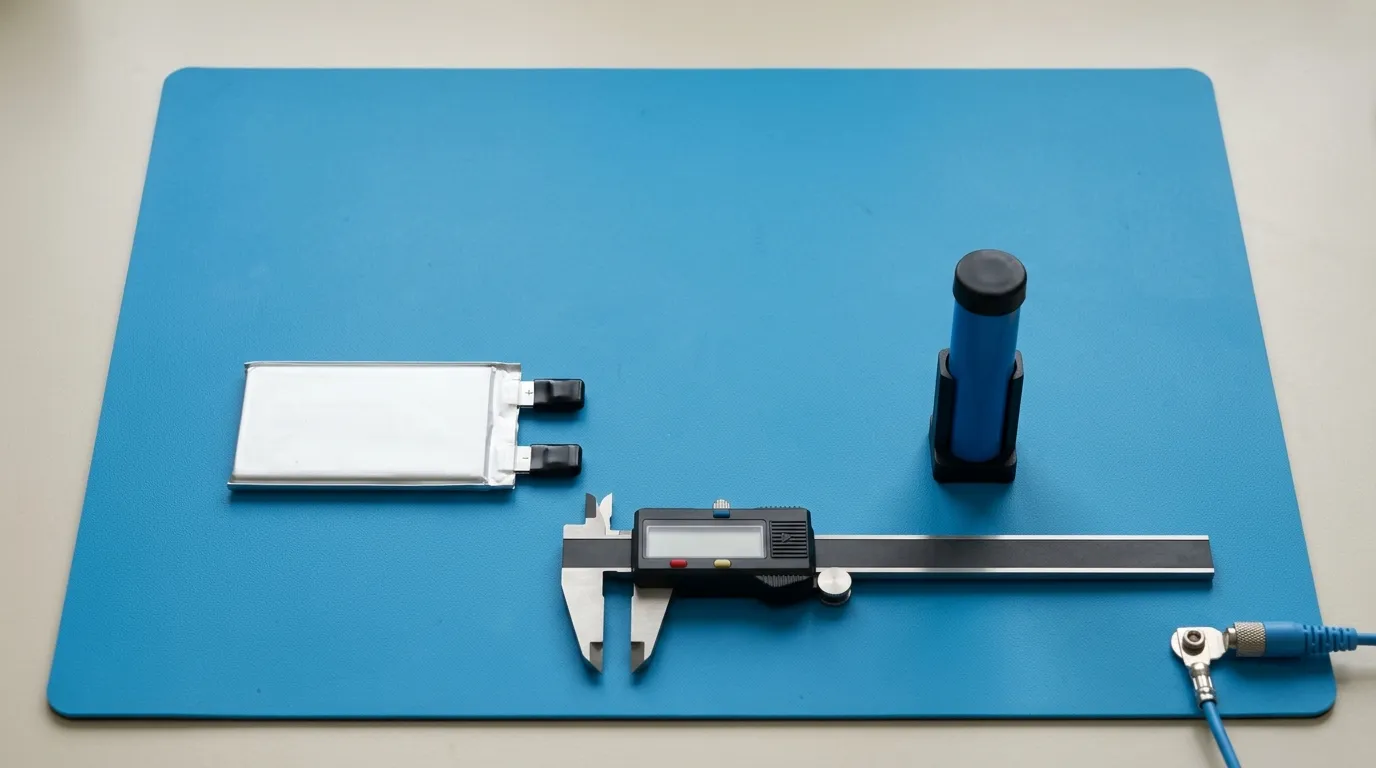
Once the load profile is defined, the next decision is chemistry and form factor. No single chemistry is the universal best choice; the correct option depends on enclosure size, energy requirement, whether the pack is rechargeable, and how often the device can be serviced.
| Chemistry | Typical Nominal Voltage | Rechargeable | Common Form Factor | Key Trade-off | Best-Fit Thermostat Architecture |
|---|---|---|---|---|---|
| Li-ion (cylindrical, e.g., 18650, 21700) | 3.6–3.7 V | Yes | Cylindrical cell | High energy density, robust, but larger and less shape-flexible | Higher-capacity designs with sufficient internal space |
| Li-polymer (LiPo, pouch) | 3.6–3.7 V | Yes | Pouch | Thin, custom-shaped, low self-discharge; requires protection and mechanical support | Compact, curved, or space-constrained enclosures |
| Primary lithium (AA, AAA, or coin) | Varies by type | No | Cylindrical or coin | Very long shelf life, high energy density, but not rechargeable | Consumer-replaceable or backup-only designs |
| Ni-MH (AA, AAA) | 1.2 V | Yes | Cylindrical | Lower cell voltage; higher self-discharge than modern low-self-discharge types | Simple rechargeable consumer designs; voltage and capacity must match device |
| LiFePO4 | 3.2 V | Yes | Cylindrical or prismatic | Longer cycle life, lower nominal voltage; lower energy density than Li-ion | Specialized designs where cycle life and voltage are more important than energy density |
For a compact thermostat with a custom enclosure, LiPo is often a strong fit. The pouch format can be manufactured in shapes that follow the available internal volume, rather than forcing the design around a fixed cylindrical cell.
Why LiPo Is Often a Strong Fit for a Compact Thermostat
Li-polymer (LiPo) cells can be produced as thin, custom-shaped pouches, which makes them a practical choice for the tight, sometimes irregular internal spaces found in modern thermostat housings. They also tend to have low self-discharge, which suits a device that spends most of its time in standby.
Gloflux's smart-home battery solutions page identifies smart thermostats as a relevant LiPo application and describes custom-shaped packs and low-self-discharge batteries for always-on smart-home devices. That said, LiPo still requires the same design disciplines as any rechargeable lithium chemistry: a protection circuit, a compatible charger, and mechanical support to prevent flexing or damage.
Voltage, Capacity, Energy, and Pack Configuration
The electrical specification sheet for a thermostat battery pack must distinguish between several quantities that are often confused:
- Nominal voltage is the cell's or pack's rated operating voltage (e.g., 3.7 V for a single Li-ion/LiPo cell). This is the value used for system design.
- Maximum charge voltage is the upper voltage limit during charging (e.g., 4.2 V per Li-ion/LiPo cell). It is not the same as nominal voltage.
- Capacity, in mAh or Ah, measures stored charge.
- Energy, in Wh, measures total stored energy and is calculated as capacity × nominal voltage. This is the more useful figure when comparing chemistries with different nominal voltages.
Series and Parallel Configuration
- Series (S) connects cells to increase voltage. A 2S pack of 3.7 V nominal cells has a nominal voltage of 7.4 V.
- Parallel (P) connects cells to increase capacity and available current. A 2P pack of a single cell's capacity doubles the mAh rating at the same voltage.
A single-cell (1S) LiPo pack is common for compact thermostats because it minimizes complexity and avoids the need for cell balancing. A multi-series pack is used only when the device requires a higher operating voltage. For example, a 7 4v 2600mah 18650 battery pack represents a 2S configuration that might suit a device requiring 7.4 V nominal—though it is rarely the default choice for a compact thermostat.
Continuous vs. Peak Current and Voltage Sag
The load profile determines both the continuous current and the peak current the pack must supply.
- Continuous current is the average sustained draw.
- Peak current is the short-duration maximum, often during radio transmission.
A battery with high internal resistance will experience voltage sag under peak load. If the voltage drops below the thermostat's minimum operating threshold—even briefly—the device may reboot, lose connectivity, or trigger a low-battery warning. The pack specification must therefore include a peak-current rating with a stated duration, not just a continuous-current figure.
Protection, Charging, and C-Wire Architecture
Does a Thermostat Battery Need a BMS?
For a rechargeable lithium battery pack, the answer is almost always yes. A minimal protection circuit (PCM) or a more capable battery management system (BMS) should provide:
- Overcharge protection.
- Over-discharge protection.
- Overcurrent protection.
- Short-circuit protection.
- Temperature protection (where required by the design).
A single-cell lithium pack can often be protected by a compact PCM. A multi-series pack (2S or higher) also requires cell balancing to keep the series cells at similar voltages, which supports pack consistency and extends usable cycle life.
A conventional BMS is distinct from a "smart" BMS or battery pack. A smart pack adds features such as a fuel gauge (state-of-charge estimation), data logging, or communication interfaces. These features are only necessary if the thermostat displays remaining battery percentage, reports battery health, or communicates with a host system.
Charging and the C-Wire
The thermostat's power architecture determines the role of the battery:
- C-wire-powered thermostats draw continuous power from the HVAC system. The battery, if present, is a backup reserve. Charging may be handled by the device itself, or the battery may be a primary cell with a long shelf life.
- Battery-only thermostats use the battery as the primary energy source. The charging circuit must match the chemistry and series count of the pack (e.g., CC/CV charging for Li-ion/LiPo).
The charging profile is a critical specification. A Li-ion/LiPo pack must not be charged beyond its maximum charge voltage, and the charge current must be limited to a safe value for the cell. The charger design is part of the device, not the battery pack, but the pack's protection circuit must be compatible with the charger's output.
When a Fuel Gauge or Communication Interface Matters
A fuel gauge is only necessary when the thermostat reports its remaining battery state to the user or to a home automation system. The communication interface (SMBus, I2C, UART, CAN, RS485, or Bluetooth) is a customization decision, not a default feature. If the thermostat does not need battery telemetry, a simpler protected pack is the more cost-effective choice.
Mechanical Integration: Connector, Enclosure, Insulation, and Thermal Path
The physical integration of the battery pack is just as important as its electrical specification.
- Connector: Specify the connector pitch, polarity, current rating, and wire gauge. A connector that cannot carry the peak current or that can be inserted with reversed polarity is a field failure waiting to happen.
- Enclosure: Define the available internal volume, including any irregular shapes. A custom LiPo pouch can be manufactured to fit unusual spaces, but it must be mechanically retained to prevent flexing, vibration, or puncture.
- Insulation: The pack must be insulated from adjacent components, especially anything that can generate heat or produce sharp edges.
- Thermal path: Consider heat dissipation during charging and discharging. A lithium pack should not be charged outside its rated temperature range, and the enclosure should allow for any permitted heat rise.
For a serviceable thermostat design, a tool-free, user-swappable pack may be required. Gloflux offers replaceable lithium battery solutions for devices where the battery must be changed by the end user. If your design calls for a field-replaceable pack, that requirement should appear in the RFQ from the start.
The same low-power design principles apply to other smart-home devices with similar duty cycles. For example, a lithium battery for smart lock faces comparable standby and peak-current challenges, as does a rechargeable battery for iot sensors and a Rechargeable battery for smart leak detectors. Each device has its own enclosure and load requirements, but the underlying selection process is the same.
Validation, Transport, and Compliance Documentation
Lithium batteries are subject to specific documentation requirements that are often confused.
UN38.3 Test Summary vs. Product Safety Certification
- UN38.3 test summary is a transport document. It confirms that a specific cell or battery has passed the UN Manual of Tests and Criteria, Section 38.3 test sequence, which includes altitude simulation, thermal test, vibration, shock, external short circuit, and overcharge. It is required for shipping lithium batteries.
- IEC 62133, UL, or CB reports are product-safety certifications for a defined model and construction. They are not the same as a transport test summary.
- ISO 9001 is a company quality-system certification. It describes the manufacturer's quality management system, not the safety of a specific product.
According to the U.S. Department of Transportation's PHMSA, lithium battery test summaries must be available from the manufacturer and should accompany shipments. Transport Canada's lithium battery transport research similarly references the UN38.3 test sequence, explicitly identifying tests T.1 through T.5 and T.7 for small rechargeable batteries.
For any lithium battery pack used in a smart thermostat, the OEM should request:
- A model-specific datasheet (TDS).
- An SDS/MSDS.
- A UN38.3 test summary for the exact cell and pack construction.
- Any applicable IEC/UL/CB report for the confirmed model scope.
- A clear statement of what the manufacturer's ISO 9001 certificate does and does not cover.
Do not accept a general company certification as evidence that a specific product model has passed its required tests. The documentation must match the exact battery you intend to ship.
Thermostat Battery Supplier RFQ Checklist

When you send a request for quotation (RFQ) to a lithium battery pack manufacturer, include the following:
Electrical requirements:
- Nominal and minimum/maximum operating voltage.
- Maximum charge voltage and charging profile.
- Capacity (mAh/Ah) and energy (Wh).
- Continuous and peak current, with the peak duration.
- The thermostat's load profile or a representative duty cycle.
- Target runtime or recharge interval.
Mechanical requirements:
- Available enclosure dimensions (and any shape constraints).
- Connector type, pitch, polarity, and wire gauge.
- Mounting and retention method.
- Weight limit, if any.
Environmental requirements:
- Charge, discharge, and storage temperature ranges.
- Any humidity, vibration, or shock requirements.
Documentation requirements:
- Model-specific TDS.
- SDS/MSDS.
- UN38.3 test summary for the exact pack.
- Applicable IEC/UL/CB reports where required.
- Traceability from cell batch to finished pack.
- Change-control procedure for any cell or BMS substitution.
Commercial requirements:
- Prototype and sample lead time.
- MOQ for pilot and mass production.
- Tooling or NRE costs, if applicable.
- Production lead time.
- Warranty terms and after-sales support.
Gloflux's products page describes its general engineering, inspection, and certification support. For a specific project, those claims must be verified against the exact model and documentation in the RFQ response. A good supplier should be able to provide the full documentation set listed above, not just a marketing summary.
Frequently Asked Questions
What voltage does a smart thermostat battery need?
There is no universal answer. The required voltage depends on the thermostat's electronics, display, and radio rails. A single Li-ion/LiPo cell (3.6–3.7 V nominal) is common, but some designs use 2S (7.4 V) packs or primary cells with different nominal voltages. The correct value comes from the device's own design, not from a generic rule.
Do thermostat batteries need a BMS?
Rechargeable lithium battery packs should include at least a protection circuit (PCM) to guard against overcharge, over-discharge, overcurrent, and short circuits. Multi-series packs also require cell balancing. A full smart BMS with fuel gauge or communication is only needed when the thermostat reports battery state to the user.
How long will a thermostat battery last?
Runtime depends on the load profile, battery capacity, operating temperature, and the thermostat's power management. A device with frequent Wi-Fi transmission will drain a battery far faster than one that enters a deep sleep mode. The only reliable way to estimate runtime is to measure the load profile and calculate the required mAh/Wh as shown earlier.
Can I use a rechargeable lithium battery in my smart thermostat?
Only if the thermostat is designed for a rechargeable lithium pack, including a compatible charging circuit and protection architecture. Swapping a primary cell for a rechargeable lithium cell without verifying the design is unsafe and may damage the device or the battery. For OEMs, this is a design decision; for consumers, the manufacturer's instructions should always be followed.
Bringing the Specification to a Battery Manufacturer
The difference between a successful thermostat battery project and a failed one is usually not the chemistry—it is the quality of the specification. A measured load profile, a clear set of electrical and mechanical limits, and a complete documentation request will get you an accurate quotation and a pack that performs as expected.
If you are at the specification stage, bring your load profile and RFQ checklist to a lithium battery pack manufacturer for review. A well-defined requirements document is the fastest path to a valid sample, a realistic timeline, and a production pack that meets your thermostat's actual operating conditions.
Talk to the Manufacturer
Resources & Insights

High Capacity Lithium Battery for Wearables: High-Voltage LiPo Cell Design
2026-10-19
Cylindrical Battery Packs for Laptops: 2S vs 3S vs 4S Battery Design
2026-10-19

Stage Lighting Battery Pack: Prevent Voltage Drop & LED Flicker
2026-10-19

Best Rechargeable Batteries for Smart Devices: Performance, Safety, and Selection Guide
2026-10-19


